Disclaimer: This article is for educational purposes only and does not constitute financial, legal, or investment advice. Credit Leverage X (CLX) educates and mentors entrepreneurs to help them responsibly access and manage business funding for sustainable growth.
Business credit profile hygiene refers to the ongoing maintenance and monitoring of your credit profile to ensure it remains optimized for funding.
Just like financial statements or operations, your credit profile is not something you set once and forget.
It is dynamic, meaning:
Without proper monitoring, small issues can quickly turn into major funding obstacles.
Lenders evaluate your profile based on current data, not past improvements.
This means:
…can reduce your approval odds immediately.
Fundability is maintained, not achieved once.
Monthly monitoring ensures your profile stays aligned with lender expectations at all times.
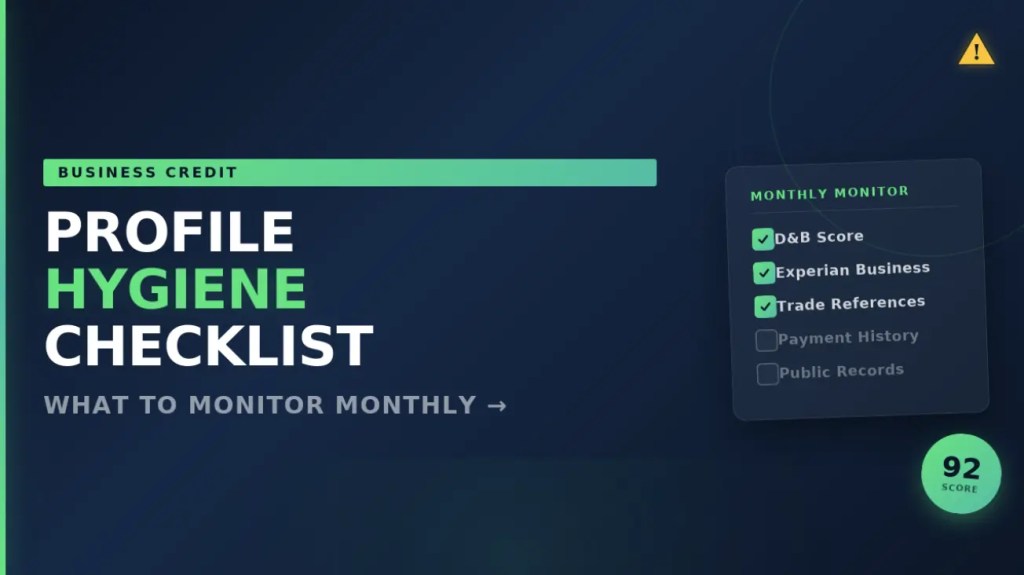
Below are the most important areas to track consistently.
Utilization is one of the fastest-moving and highest-impact signals.
High utilization signals dependency on credit, which reduces approval odds.
Payment history is a foundational trust signal.
Even one late payment can significantly impact risk perception.
Recent activity is a strong indicator of borrower behavior.
Clusters of activity signal aggressive credit seeking, which lenders view as risk.
The age of your accounts contributes to profile strength.
Older accounts signal experience and stability in managing credit.
Closing accounts can reduce your profile strength.
Your total available credit impacts utilization and borrowing capacity.
Higher limits improve your capacity profile and reduce utilization percentages.
Each account reports at different times.
Incorrect timing can cause higher utilization to be reported, even if you pay on time.
Modern underwriting increasingly looks beyond credit reports.
Banking behavior supports your overall financial profile and strengthens approval decisions.
Use this checklist every month:
| Area | What to Check | Target |
|---|---|---|
| Utilization | All cards | Under 30%, ideally 1–10% |
| Payments | All accounts | 100% on-time |
| Inquiries | Recent activity | Minimal |
| Account Age | Stability | No unnecessary closures |
| Limits | Available credit | Increasing over time |
| Statement Timing | Reporting balances | Optimized |
| Banking Activity | Cash flow consistency | Stable |
Small utilization spikes or minor errors can compound over time.
Multiple applications in a short period can reduce approval chances.
No activity can weaken your profile just as much as overuse.
Errors, outdated data, or incorrect reporting can go unnoticed.
To maintain strong business credit hygiene, create a simple monthly system:
Choose a consistent date each month to review your profile.
Use a spreadsheet or dashboard to monitor:
Make necessary payments or adjustments before statement dates.
Track trends over time to identify improvements or risks.
Maintaining your business credit profile monthly leads to:
Over time, this creates a compounding advantage in your ability to scale.
Most business owners focus on getting approved once.
But high-level operators understand:
Consistent monitoring creates consistent approvals.
By maintaining strong business credit hygiene every month, you position yourself to:
Business credit monitoring is the process of tracking your credit profile regularly to ensure accuracy and maintain strong fundability signals.
You should review your profile at least once per month to catch issues early and optimize performance.
Credit utilization and payment history are two of the most important factors affecting approvals.
Yes. Even minor changes in utilization or activity can significantly affect lender perception.
Consistency shows lenders that you can manage credit responsibly over time, which improves approval odds.
A better credit score starts with the right strategy. Let Credit Leverage X help you take control of your finances, improve your credit, and unlock the funding you deserve.
Start Your Credit Strategy





Subscribe now to keep reading and get access to the full archive.