Disclaimer: This article is for educational purposes only and does not constitute financial, legal, or investment advice. Credit Leverage X (CLX) educates and mentors entrepreneurs to help them responsibly access and manage business funding for sustainable growth.
When most business owners attempt to “stack” credit, they approach it with the wrong mindset from the beginning.
They assume the goal is simple: apply to multiple lenders and secure as much capital as possible in a short period of time.
On the surface, that sounds logical. More applications should mean more approvals.
But lenders don’t see it that way.
From their perspective, a sudden increase in credit-seeking behavior sends a very specific signal—one that has nothing to do with opportunity and everything to do with risk.
It suggests urgency.
It suggests instability.
And most importantly, it suggests uncertainty about repayment.
This is why so many people get stuck in a frustrating cycle of partial approvals, reduced limits, or outright denials.
Not because they lack eligibility—but because they triggered the wrong perception.
Credit stacking is often misunderstood as a tactic.
In reality, it’s a strategy of controlled exposure.
You are not simply applying for credit—you are managing how your profile is interpreted across multiple institutions at the same time.
That distinction matters.
Because every lender evaluates your profile independently, but they all look for the same signals:
Stacking works when those signals are preserved—even while you are expanding your access to capital.
It fails when your behavior contradicts them.
Most people focus only on credit cards when they think about stacking.
And while cards are an important piece of the puzzle, they are not the full system.
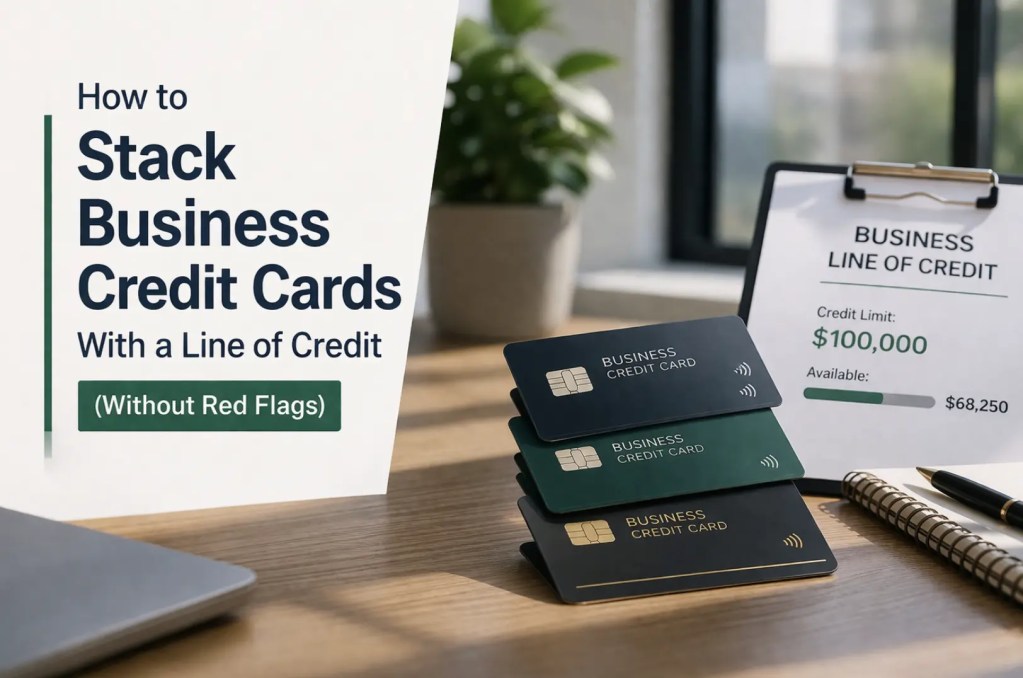
Credit cards provide speed and flexibility. They are typically easier to access, faster to deploy, and often come with promotional terms that make them attractive for short-term capital.
But they also come with limitations.
They are more sensitive to utilization.
They are often lower in limit compared to other products.
And when overused, they quickly shift how lenders perceive your risk.
Lines of credit, on the other hand, serve a different role.
They tend to provide higher access, more stability, and a different type of signal to lenders—one that suggests structured borrowing rather than reactive spending.
When you combine the two, you are not just increasing capital.
You are building a layered capital profile.
One that shows flexibility on one side, and stability on the other.
Most people think red flags come from the number of applications.
That’s only partially true.
Red flags come from patterns.
Lenders are not just looking at what you’re doing—they’re looking at how it looks.
For example, applying for multiple accounts is not inherently risky.
But applying:
…creates a pattern that suggests instability.
And once that pattern is detected, it becomes harder to reverse.
This is why two people can apply for the same products, at the same time, with similar credit scores—and get completely different outcomes.
One looks controlled.
The other looks reactive.
Before any applications are submitted, the profile itself has to be positioned correctly.
This is where most people rush—and where most mistakes happen.
Because stacking doesn’t begin with applications.
It begins with perception.
Your goal at this stage is simple:
👉 Make your profile look stable, low-risk, and intentional.
That means reducing anything that could signal urgency or instability.
Balances should be low.
Recent activity should be minimal.
Your accounts should reflect consistency—not fluctuation.
At this point, you are not trying to get approved.
You are preparing to get approved multiple times.
Once your profile is positioned, the first layer typically involves business credit cards.
This is where timing becomes critical.
When applications are submitted within a controlled window, they often do not fully reflect across all systems immediately. This creates a short opportunity where multiple lenders are evaluating your profile based on the same snapshot—before new activity updates.
But this only works when done correctly.
If applications are spread out too far, each new inquiry begins to influence the next decision.
If they are rushed without preparation, they trigger immediate concern.
This is why the goal is not to apply fast—it’s to apply in a controlled sequence that preserves your profile integrity.
After initial approvals are secured, the next step is introducing a line of credit.
This is where most people either move too quickly or wait too long.
Applying too early can signal that you are aggressively seeking more capital immediately after new approvals.
Waiting too long can reduce the advantage of your current positioning.
The key is balance.
At this stage, your profile should still reflect:
When a line of credit is added at the right time, it strengthens your profile rather than weakening it.
It shows lenders that your borrowing behavior is structured—not reactive.
Timing is one of the most misunderstood elements of credit strategy.
Most people think in terms of eligibility.
But approvals are just as dependent on when you apply as they are on whether you qualify.
If your profile shows recent stress, even strong applicants can be denied.
If your profile shows stability, approvals tend to come easier—and often with higher limits.
This is why stacking is not about compressing everything into the shortest timeframe possible.
It’s about choosing the right moment—when your profile tells the right story.
The process doesn’t end once approvals are secured.
In many ways, this is where the real work begins.
Because now your profile has changed.
You have more access.
More exposure.
And more responsibility to manage how that access is used.
If utilization spikes too quickly, the signal shifts.
If payments are inconsistent, the profile weakens.
If new inquiries continue, the perception changes again.
This is why the post-stacking phase is about stabilization.
Maintaining low utilization.
Making consistent payments.
Allowing accounts to season.
This is what turns stacking from a one-time event into a long-term advantage.
Two people can follow the same general idea and get completely different results.
The difference comes down to intention.
Random stacking is driven by opportunity.
Strategic stacking is driven by structure.
One focuses on getting approvals.
The other focuses on building a system.
Credit stacking, when done correctly, is one of the most powerful ways to access capital without relying on traditional lending structures.
But it is not about volume.
It is about control.
Every action you take—every application, every balance, every timing decision—feeds into how lenders interpret your profile.
And once you understand that, everything changes.
You stop chasing approvals.
And start managing perception.
Because at the highest level, that’s what this really is:
Not a credit strategy.
But a positioning strategy.
What is credit stacking?
Credit stacking is the process of securing multiple credit approvals in a structured way without damaging your profile.
Why combine credit cards and lines of credit?
Because they serve different roles—cards provide flexibility, while lines of credit provide stability and larger access.
What triggers red flags during stacking?
Inconsistent behavior, high utilization, and poorly timed applications.
Is stacking safe?
Yes, when done with proper sequencing and profile management.
What matters most in stacking?
Timing, perception, and discipline—not just the number of applications.
A better credit score starts with the right strategy. Let Credit Leverage X help you take control of your finances, improve your credit, and unlock the funding you deserve.
Start Your Credit Strategy




Subscribe now to keep reading and get access to the full archive.