Disclaimer: This article is for educational purposes only and does not constitute financial, legal, or investment advice. Credit Leverage X (CLX) educates and mentors entrepreneurs to help them responsibly access and manage business funding for sustainable growth.
Being “overleveraged” is not about having debt — it’s about lacking control and cash flow
Credit leverage becomes dangerous when repayment depends on hope instead of structure
Strategic business funding can increase ROI when supported by discipline and predictability
Leverage is risky when reactive — powerful when planned
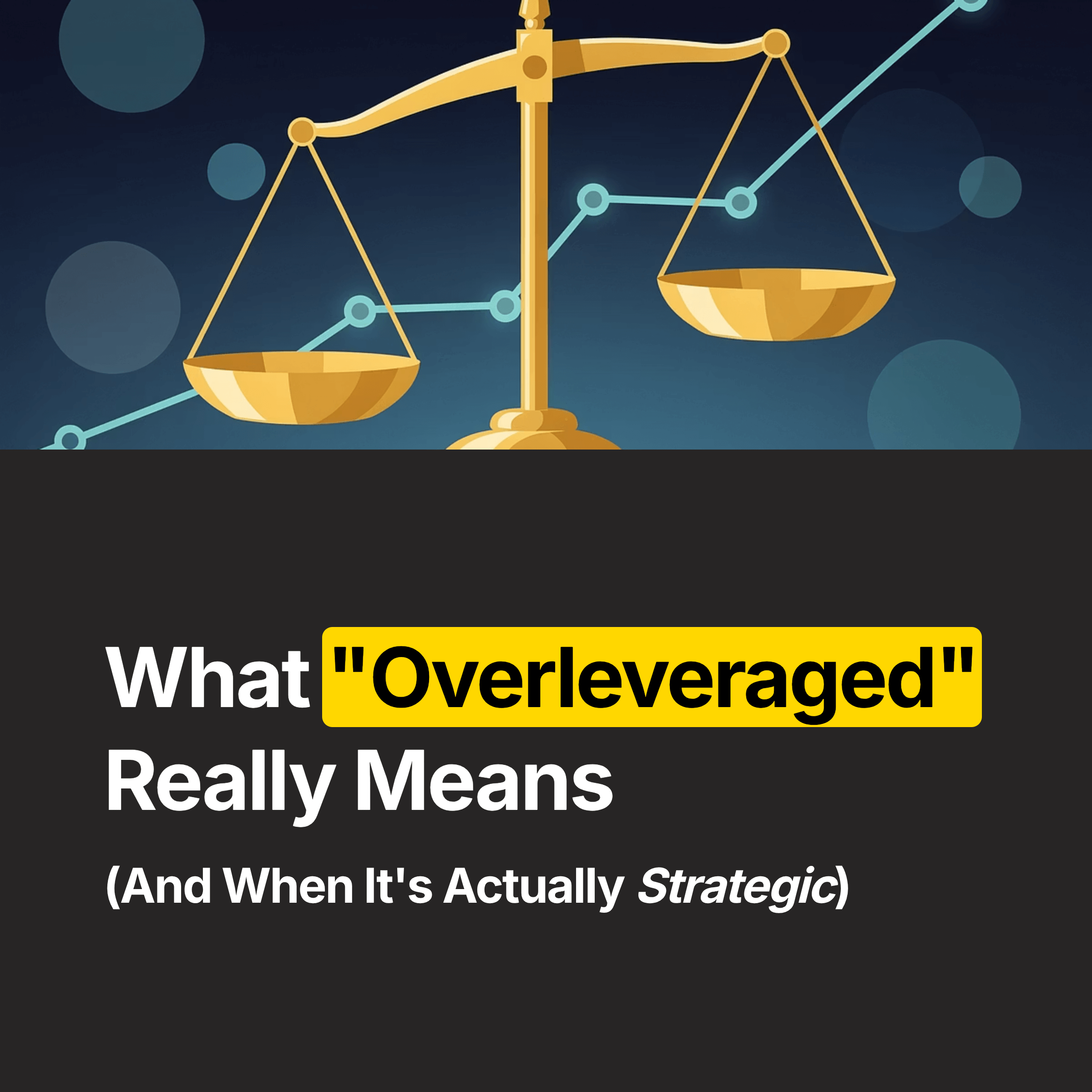
In business conversations, the word “overleveraged” carries fear.
It suggests:
Too much debt
Too much risk
Too much exposure
But here’s the reality:
Leverage itself is not the problem.
Mismanaged leverage is.
Some of the most successful businesses in the world operate with significant leverage. The difference is structure, cash flow visibility, and discipline.
Understanding what “overleveraged” really means allows founders to use credit leverage strategically — without crossing into instability.
A business is truly overleveraged when:
Debt payments exceed predictable cash flow
Utilization is consistently maxed out
New capital is used to pay old capital
There is no clear ROI on deployed funds
Repayment depends on future hope rather than present structure
Overleverage is not about the amount of business funding.
It’s about the relationship between obligations and stability.
High leverage can be strategic.
Overleverage is fragile.
Here’s the distinction:
| High Leverage (Strategic) | Overleverage (Risky) |
|---|---|
| Controlled utilization | Maxed-out accounts |
| Predictable cash flow | Volatile revenue |
| Measured ROI | Unclear returns |
| Planned repayment | Reactive repayment |
| Growth-focused | Survival-focused |
The issue is not leverage — it’s misalignment.
Strategic credit leverage exists when:
Capital is deployed toward measurable revenue growth
Cash flow comfortably covers repayment schedules
Utilization remains under control
Multiple capital sources are managed intentionally
There is buffer liquidity
In these situations, business funding accelerates growth.
Leverage increases ROI rather than stress.
When structured properly, leverage allows businesses to:
Scale marketing before competitors
Invest in automation
Hire capacity-building talent
Purchase assets below market timing
Increase operational efficiency
Strategic leverage compresses time.
It allows businesses to act now rather than wait.
Founders should monitor for:
Consistent 70–90% utilization
Difficulty making minimum payments
Rolling balances from one account to another
Funding being used to cover losses
Increased stress around repayment
If capital feels heavy rather than empowering, structure needs adjustment.
Cash flow is the anchor of safe leverage.
Before expanding business funding, ask:
Is revenue predictable?
Is margin stable?
Is repayment covered without strain?
Is there a contingency plan?
Leverage without visibility creates risk.
Leverage with visibility creates acceleration.
Even profitable businesses can appear overleveraged to lenders if:
Credit utilization is high
Spending spikes are volatile
Payment timing is inconsistent
Maintaining utilization under 30% protects:
Credit score health
Future approvals
Long-term access to capital
Control signals stability.
Fear of being “overleveraged” leads some founders to avoid capital completely.
This creates another problem:
Missed opportunities
Slower scaling
Lower competitive positioning
Delayed infrastructure investment
Avoiding all leverage is not necessarily conservative — it can be limiting.
The goal is disciplined leverage, not zero leverage.
To ensure leverage remains strategic:
Never use funding without clear return expectations.
Avoid consistently high balances.
Project cash flow before committing.
Scale only when systems and margins support it.
Always maintain emergency reserves.
Structure converts leverage into advantage.
Stress around leverage often comes from uncertainty.
Prepared founders experience:
Clarity
Visibility
Scheduled repayment
Planned allocation
Unprepared founders experience:
Pressure
Reaction
Anxiety
Instability
The financial numbers may be similar.
The structure is what changes the experience.
As a strategic funding company, Credit Leverage X helps clients:
✅ Build structured business funding plans
✅ Maintain disciplined utilization
✅ Deploy credit leverage strategically
✅ Protect long-term capital access
✅ Scale without crossing into instability
We focus on controlled leverage — not reckless stacking.
Overleverage is about instability, not simply debt size
Strategic credit leverage accelerates growth
Utilization discipline protects long-term funding potential
Cash flow visibility determines safety
Leverage should feel empowering, not stressful
Book a no-cost strategy call and get expert guidance, personalized solutions, and real opportunities to move your goals forward.
Get StartedNot if utilization and repayment are controlled.
When repayment exceeds predictable cash flow or stress increases.
Yes, if utilization and obligations are misaligned with cash flow.
It may reduce risk, but it can also limit growth potential.
Primarily through utilization levels, payment behavior, and cash flow stability.
A better credit score starts with the right strategy. Let Credit Leverage X help you take control of your finances, improve your credit, and unlock the funding you deserve.
Start Your Credit Strategy






Subscribe now to keep reading and get access to the full archive.