Disclaimer: This article is for educational purposes only and does not constitute financial, legal, or investment advice. Credit Leverage X (CLX) educates and mentors entrepreneurs to help them responsibly access and manage business funding for sustainable growth.
When entrepreneurs think about funding, their first instinct is usually to focus on one number:
How much can I get?
How much can I be approved for?
How much capital can I raise?
How much leverage can I access?
While that question matters, it is incomplete.
Because in practice, the amount of capital you secure is only one part of the equation.
What matters just as much—often more—is:
How quickly that capital produces a return and becomes reusable again.
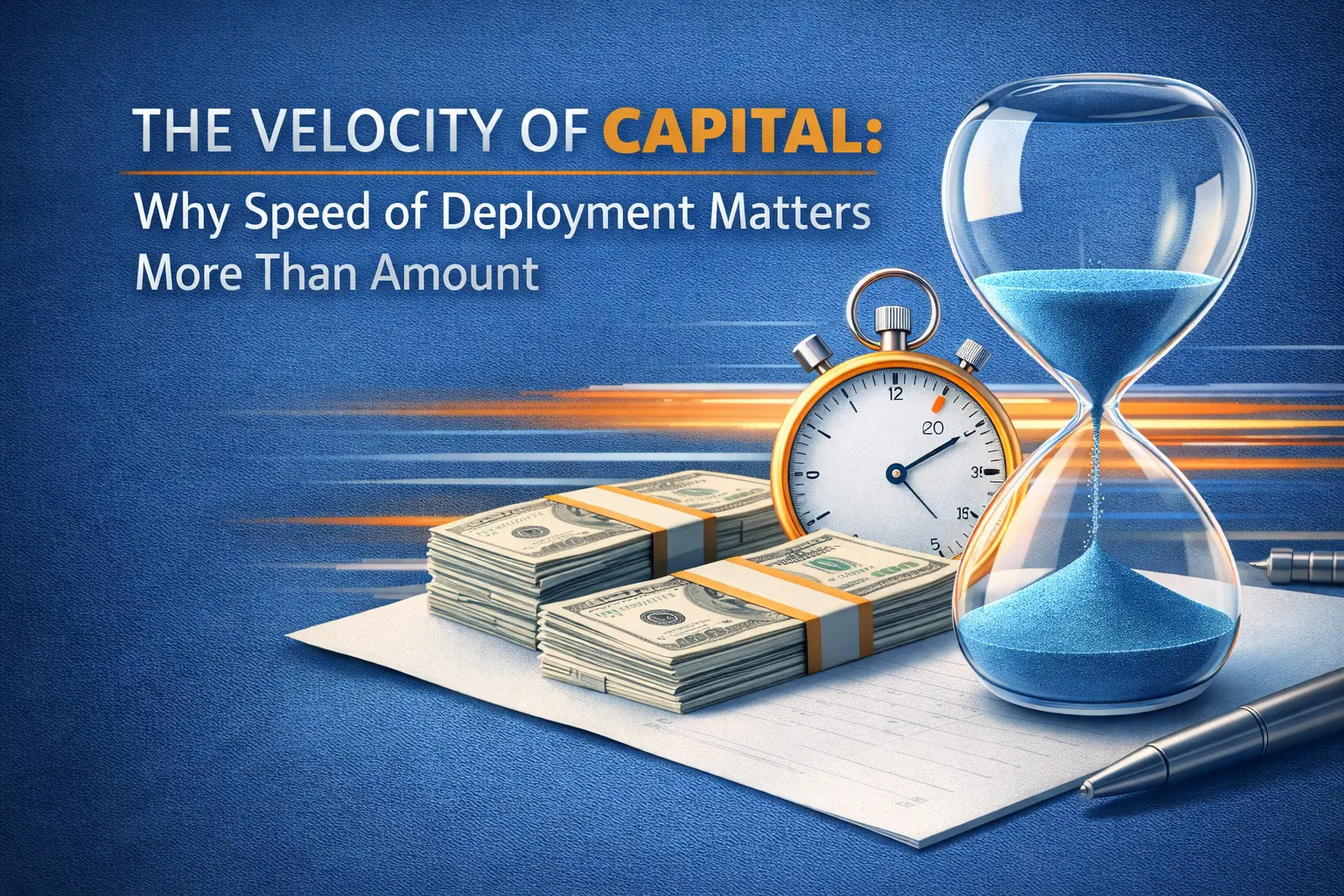
This is the concept of capital velocity.
And it is one of the most overlooked principles in business scaling.
Capital velocity refers to the speed at which deployed capital cycles back into the business after being invested.
In simple terms:
It measures how quickly your money returns after deployment.
The faster capital returns:
This means a business with lower total funding but faster capital velocity can often outperform one with larger funding but slower deployment efficiency.
Many operators celebrate large approvals.
And while access to capital is valuable, capital sitting idle creates no return.
Unused capital:
Likewise, poorly deployed capital can destroy value regardless of amount.
A business that raises $500K and deploys it inefficiently may underperform one that raises $100K and deploys it precisely.
Because capital is not valuable by default.
It becomes valuable only when it moves productively.
Sophisticated operators do not treat funding as an achievement.
They treat it as inventory.
Inventory that must be deployed strategically and recycled efficiently.
The goal is not:
“To hold more capital.”
The goal is:
“To make each dollar move faster and harder.”
That is the mindset shift.
At a strategic level, capital velocity is influenced by two variables:
| Variable | Meaning |
|---|---|
| Speed of Deployment | How quickly capital is put to productive use |
| Speed of Recovery | How quickly deployed capital returns as cash flow |
Higher Velocity = More Growth Per Dollar
Capital loses effectiveness when it sits idle.
Every day undeployed capital remains unused:
Many businesses secure funding without a deployment plan.
Then spend weeks or months deciding what to do with it.
By then:
Capital should ideally be deployed with intention immediately after acquisition.
Deployment alone is not enough.
Capital must also return quickly.
This is where ROI and velocity intersect.
Consider two investments:
| Investment | ROI | Time to Return |
|---|---|---|
| Campaign A | 30% | 30 Days |
| Campaign B | 50% | 180 Days |
Many people instinctively choose Campaign B.
But over time, Campaign A may produce far greater total output because capital recycles faster.
Higher velocity often beats higher isolated ROI.
When capital cycles quickly, each dollar can be redeployed multiple times per year.
This creates multiplicative growth.
$100,000 deployed once annually at 30% ROI:
$130,000 annual output
$100,000 deployed every 90 days at 15% ROI:
Far greater cumulative annual output due to repeated cycles
The exact ROI per deployment matters less when velocity increases enough.
Some business models inherently benefit from faster capital cycles.
Examples include:
These businesses can scale aggressively because capital recycles rapidly.
Other models require more patience.
Examples include:
These businesses often require larger capital reserves because funds remain tied up longer.
Elite operators structure business models to improve capital speed.
They focus on:
Because every operational improvement that increases velocity enhances growth potential.
Large funding amounts can actually hurt businesses when velocity is low.
Because slow-moving capital often leads to:
Abundance without discipline can destroy efficiency.
Scarcity with precision often produces better operators.
Business A secures $500K and deploys slowly over 12 months.
Business B secures $150K and cycles it every 90 days.
By year-end, Business B may have created more total economic output—
Despite raising far less capital.
Because the difference was not access.
It was movement.
Sophisticated operators ask a different question than most founders.
They do not ask:
“How much capital do we need?”
They ask:
“How quickly can this capital turn into cash flow and be redeployed?”
That question reflects true operational maturity.
Because capital efficiency—not just capital access—is what drives elite scaling.
Capital amount matters.
But only to a point.
Beyond that, speed becomes more important than size.
Because the businesses that scale fastest are rarely the ones with the most capital.
They are the ones whose capital moves the fastest.
They deploy quickly.
Recover quickly.
Redeploy repeatedly.
That is how small pools of capital create outsized outcomes.
Because in the end:
It is not just how much money you have—
It is how fast that money moves.
What is capital velocity?
It is the speed at which deployed capital returns to the business and becomes reusable.
Why does capital velocity matter?
Because faster recycling of capital increases total growth potential.
Is more funding always better?
No—inefficiently deployed capital creates little value.
What improves capital velocity?
Faster sales cycles, quicker collections, higher inventory turns, and shorter deployment windows.
Why do sophisticated operators focus on velocity?
Because growth is driven by capital efficiency, not just capital access.
A better credit score starts with the right strategy. Let Credit Leverage X help you take control of your finances, improve your credit, and unlock the funding you deserve.
Start Your Credit Strategy





Subscribe now to keep reading and get access to the full archive.