Disclaimer: This article is for educational purposes only and does not constitute financial, legal, or investment advice. Credit Leverage X (CLX) educates and mentors entrepreneurs to help them responsibly access and manage business funding for sustainable growth.
TL;DR
Business credit isn’t an extension of personal credit. It’s a separate financial identity — and if you haven’t built it deliberately, you don’t have it. Full stop.
The mistake most operators make is treating business credit as something that accumulates passively over time. It doesn’t. It requires intentional structure, sequenced execution, and an understanding of how the business credit bureaus actually evaluate your company. Get the structure wrong and you’ll spend years wondering why lenders keep asking for personal guarantees.
Here’s what serious operators do differently: they build a credible business entity first, then pursue credit — not the other way around.
Before a single trade line is opened, your business needs to look fundable to the financial system. That means:
These aren’t administrative formalities. They’re the signals lenders and bureaus use to determine whether your business is a real, operating entity or a liability risk. Dun & Bradstreet, for instance, will not issue a DUNS number — your D&B business credit identifier — without a verifiable business address and phone listing. The SBA outlines entity setup requirements that align directly with what credit bureaus expect to see.
Personal credit runs through Equifax, Experian, and TransUnion — scored via FICO. Business credit runs through a parallel system with different players, different scoring models, and different rules.
| Bureau | Primary Score | Score Range | Key Factor |
|---|---|---|---|
| Dun & Bradstreet | PAYDEX | 0–100 | Payment timeliness |
| Experian Business | Intelliscore Plus | 1–100 | Payment + public records |
| Equifax Business | Business Credit Risk | 101–992 | Delinquency prediction |
A PAYDEX score of 80 means you pay on time. A score of 100 means you consistently pay early. Lenders extending larger credit lines — the $100K+ tier — want to see scores above 80 across at least two bureaus before they’ll move without a personal guarantee.
Your goal isn’t just to have scores. It’s to have verified trade lines reporting to multiple bureaus simultaneously. That’s how you build a business credit profile that can actually support a capital raise.
Register for a DUNS number through Dun & Bradstreet’s website — it’s free and takes 30 days via standard processing. Once issued, monitor your D&B profile actively. Errors in business credit reports are common and damaging. The CFPB has noted that inaccurate reporting affects financing access significantly — and business credit files have even less regulatory correction infrastructure than consumer files.
Also register your business with Experian Business and Equifax Business directly. Some vendor trade lines only report to one bureau. You need coverage across all three to build a robust, lender-ready profile.
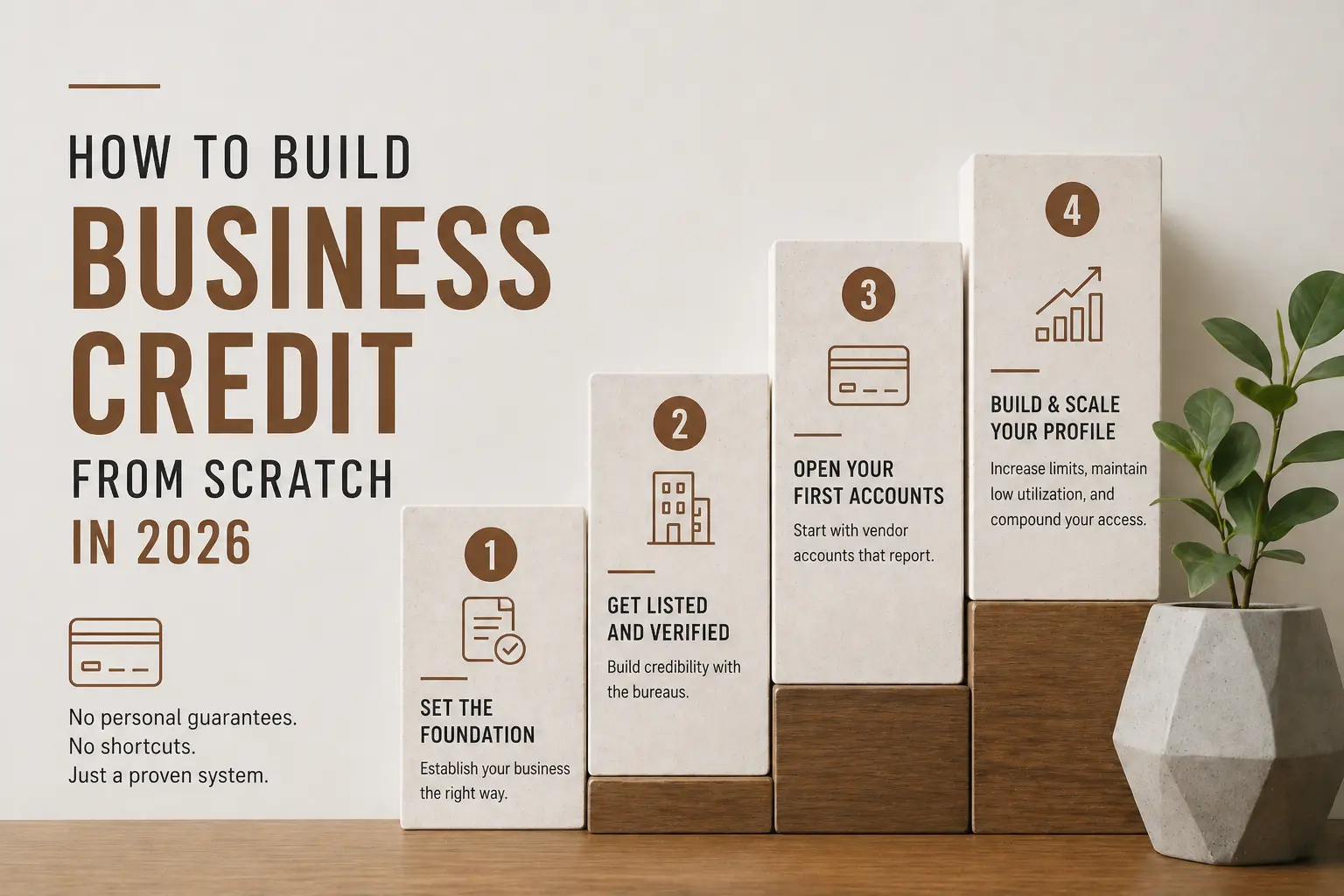
This is the actual framework — not theory. Serious operators move through three tiers in sequence. Skipping tiers is how operators end up with a business credit profile that looks a year old when it’s actually three years old.
Net-30 accounts are the entry point. These are vendors who extend you $500–$2,500 in credit and report payment history to the business bureaus. You purchase, pay within 30 days, and a trade line is established.
The right vendor accounts to start with are those that don’t require an existing credit profile to approve — sometimes called “starter vendors” or “tier 1 vendors.” Examples include Uline, Quill, Grainger, and Crown Office Supplies. Use these accounts for legitimate business purchases. Pay early — before the 30-day mark — to build toward a PAYDEX of 100 rather than 80.
Open 5–8 vendor accounts within the first 60–90 days. Let them report for two to three billing cycles before advancing.
Once you have 5+ trade lines reporting and a PAYDEX above 75, you’re positioned to apply for business credit cards — ideally those that don’t require a personal guarantee or that report only to business bureaus.
This is where understanding credit leverage becomes critical. A business card with a $10,000 limit held at 10–15% utilization reports as a strong positive trade line. The same card maxed out does the opposite — and the damage compounds across bureaus.
Target cards from issuers like Divvy, Brex, or business cards through regional banks that report to business bureaus, not personal ones. National banks often cross-report — read the terms.
| Tier | Account Type | Credit Range | Bureaus Typically Reporting |
|---|---|---|---|
| 1 | Net-30 Vendors | $500–$2,500 | D&B, Experian Business |
| 2 | Business Credit Cards | $2,000–$25,000 | D&B, Experian, Equifax |
| 3 | Bank Lines / SBA | $25,000–$250,000 | All three + bank internal |
Bank credit — revolving lines of credit, term loans, SBA 7(a) products — requires a mature profile. Mature means: 12+ months in business, 8+ trade lines reporting, scores above 80 across bureaus, and a business banking relationship with demonstrable cash flow.
The SBA 7(a) loan program can extend up to $5 million for qualified businesses, but the underwriting process heavily weights business credit history alongside personal credit. Operators who’ve built Tier 1 and Tier 2 properly arrive at Tier 3 with leverage. Those who haven’t arrive with a personal guarantee requirement — or a rejection.
For operators looking to convert that capital into measurable revenue growth, the strategic framework in how to turn $50K into $250K in revenue applies directly once the credit capacity is in place.
Stop expecting business credit to build in 30 days. Stop expecting it to take five years. The actual timeline for a correctly structured build looks like this:
| Milestone | Realistic Timeline |
|---|---|
| Entity setup + EIN + DUNS registration | Week 1–2 |
| First 5 vendor accounts opened | Month 1 |
| First trade lines reporting to bureaus | Month 2–3 |
| PAYDEX 70–80 established | Month 3–4 |
| Tier 2 credit cards approved | Month 4–6 |
| Lender-ready profile (Tier 3 eligible) | Month 9–12 |
Operators who execute this correctly and consistently are positioned to access business funding solutions in the $50K–$250K range within the first year — without pledging personal assets.
Three execution errors account for the majority of stalled business credit builds:
Mixing personal and business finances. Using a personal card for business purchases or depositing business revenue into a personal account destroys the clean separation lenders need to see. It also signals disorganization to underwriters.
Applying for credit before the profile exists. Hard inquiries on a thin business credit file signal desperation, not creditworthiness. Build the foundation first — then apply with purpose.
Ignoring bureau monitoring. An erroneous late payment from a vendor who misapplied your check can tank a PAYDEX score by 20+ points. Operators who don’t monitor their profiles don’t catch these errors until they’re denied financing.
According to Experian’s business credit research, many small businesses have no credit profile at all — which means they’re invisible to lenders. Invisible doesn’t mean safe. It means uncapitalizable.
Business credit in 2026 rewards operators who treat it like the asset it is. The framework hasn’t changed: build your entity credibility, establish vendor trade lines, advance through the tiers, and maintain bureau-level discipline throughout.
What has changed is the competitive environment. More operators are pursuing business credit now than five years ago. The ones who execute the full system — not shortcuts — are the ones sitting across from lenders with clean profiles, strong scores, and leverage.
That’s the position worth building toward.
A correctly structured business credit build takes 9–12 months to reach a lender-ready profile eligible for Tier 3 bank credit. The first trade lines typically begin reporting in months 2–3, and a foundational PAYDEX score of 70–80 is achievable by month 4 with consistent on-time or early payments.
No. Tier 1 vendor accounts — the starting point for any business credit build — typically don’t require revenue history or an existing credit profile. You need a registered business entity, an EIN, a business address, and a business bank account. Revenue becomes more relevant at Tier 3 when applying for bank lines and SBA products.
Yes, but not immediately. Many Tier 1 vendor accounts approve based on your business profile alone. Some Tier 2 cards (like Brex or Divvy) use business financials rather than personal credit. However, most traditional bank lines and SBA products will still review personal credit as part of underwriting, especially for businesses under two years old.
FICO scores (300–850) measure personal creditworthiness based on personal payment history, utilization, and account age. PAYDEX (0–100) measures business payment behavior only — specifically how early or late your business pays its vendors. A PAYDEX of 80 means on-time payment; 100 means consistently early payment. Lenders targeting $100K+ credit lines typically want PAYDEX above 80.
A minimum of 5 reporting trade lines is the standard threshold before pursuing Tier 2 credit cards. Fewer than that and your profile is too thin to score competitively — and hard inquiries on a thin file can do more damage than good. Wait for two to three billing cycles of confirmed reporting before applying.
A better credit score starts with the right strategy. Let Credit Leverage X help you take control of your finances, improve your credit, and unlock the funding you deserve.
Start Your Credit Strategy



Subscribe now to keep reading and get access to the full archive.