Disclaimer: This article is for educational purposes only and does not constitute financial, legal, or investment advice. Credit Leverage X (CLX) educates and mentors entrepreneurs to help them responsibly access and manage business funding for sustainable growth.
TL;DR
The question isn’t “Can I get funded?” Almost anyone can get funded — at the wrong terms, with the wrong products, at the wrong cost. The real question is: Are you positioned to access capital in a way that builds leverage instead of creating drag?
Credit leverage is a disciplined strategy. It’s the deliberate use of borrowed capital — primarily at 0% or low interest — to generate returns that exceed your cost of funds. Done right, it’s one of the most powerful tools available to a small business operator. Done wrong, it overextends your credit profile, stacks high-interest debt, and limits your options for years.
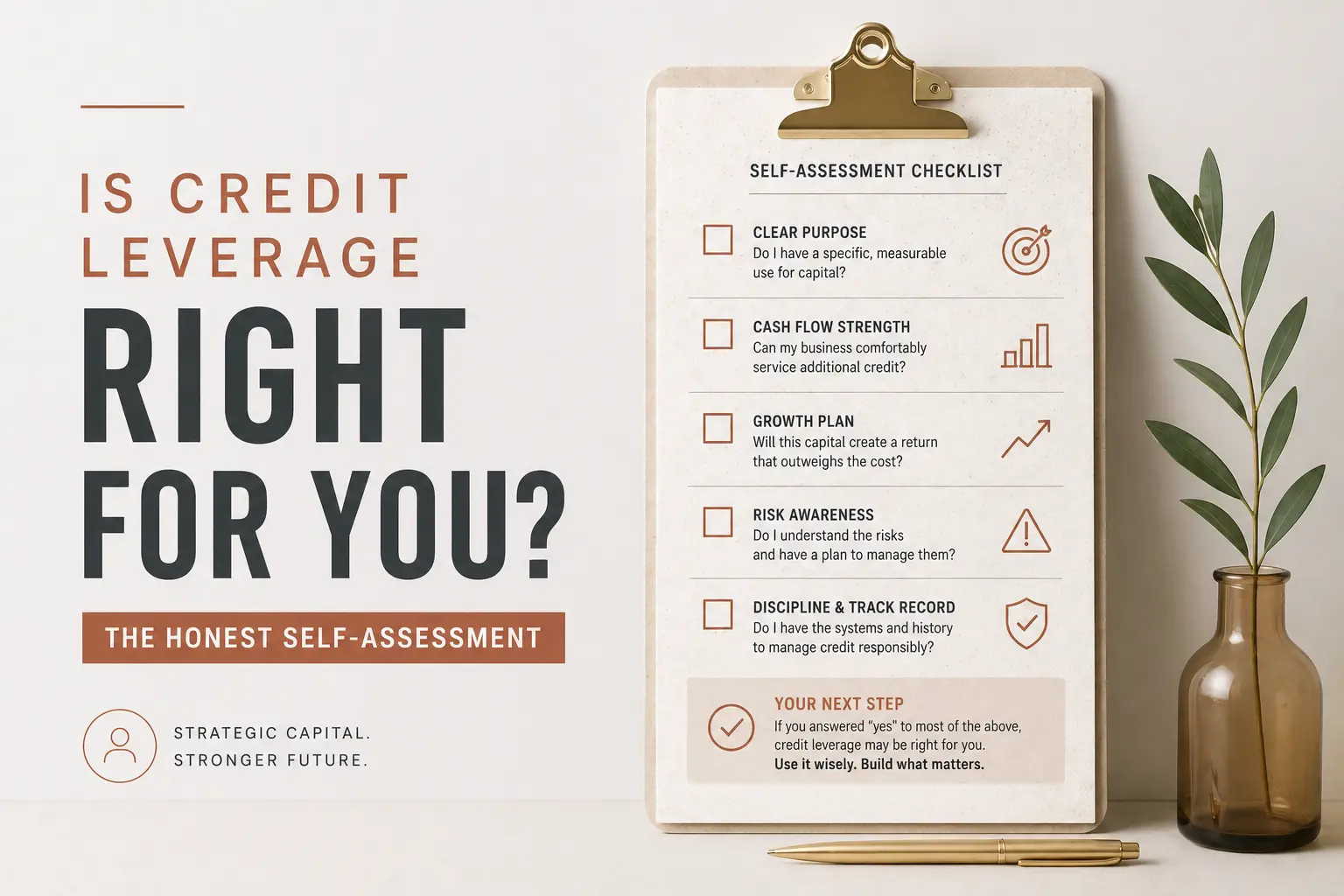
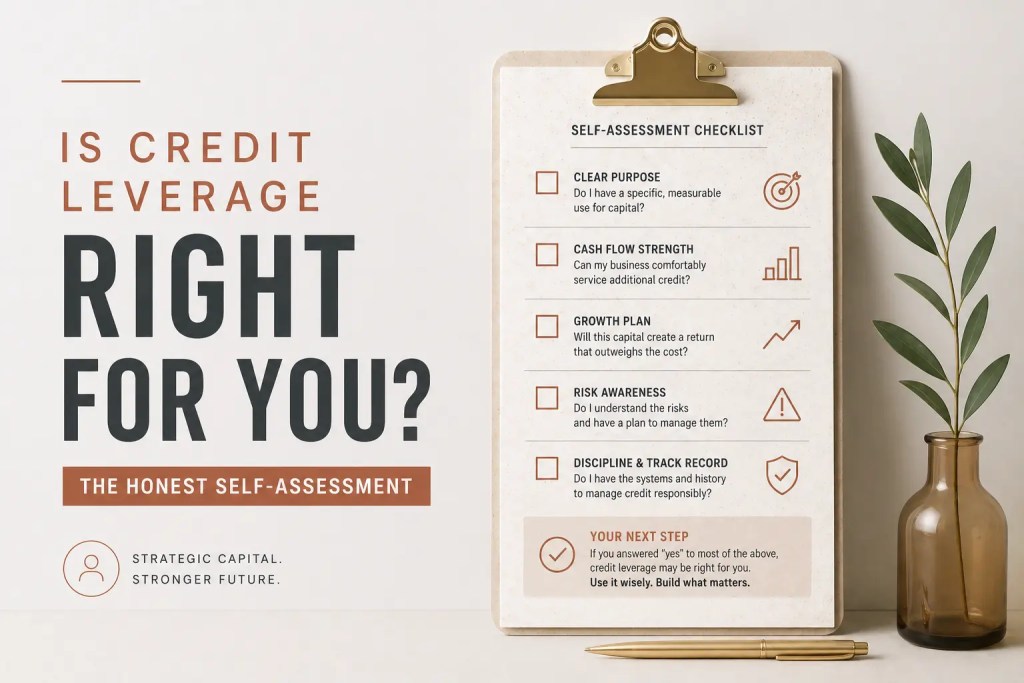
This assessment cuts through the noise. Work through each section honestly.
—
For unsecured business funding in the $50K–$250K range, your personal credit score is the primary underwriting variable. Lenders use it as a proxy for financial discipline — how you manage personal obligations signals how you’ll manage business capital.
Most operators have heard “you need good credit” without understanding the specific breakpoints that determine product access:
| Credit Score Range | Funding Access Level |
|---|---|
| 750+ | Premium — 0% intro APR cards, highest limits, best stacking potential |
| 720–749 | Strong — Most business credit products available |
| 680–719 | Moderate — Access with selectivity; some lenders will tier you down |
| 640–679 | Limited — Higher rates, lower limits, restricted product set |
| Below 640 | Rebuild phase — Not yet positioned for leverage strategies |
If you’re below 680, credit leverage isn’t your next move — credit repair and profile optimization is. The credit leverage strategy only performs when the foundation underneath it is solid.
A score is a summary. Underwriters read the full story. Before you apply for anything, audit these factors:
According to the Consumer Financial Protection Bureau, payment history alone accounts for 35% of your FICO score — making it the single highest-leverage factor to protect and optimize.
—
Personal credit opens the door. Business fundability determines how wide it opens.
Most operators skip business entity setup entirely or do it wrong — a sole proprietorship with no EIN, no business bank account, and no trade lines. That profile doesn’t get funded at scale. It gets offered high-interest merchant cash advances and revenue-based products that extract value instead of creating it.
Run through this honestly:
If you’re missing more than two of these, your business entity isn’t lender-ready regardless of your personal score. Fix the infrastructure before pursuing capital.
Understanding the 2-2-2 credit rule can also clarify how issuers evaluate your application history and timing — it directly affects how you sequence applications to maximize approvals without burning your profile.
—
Funding without a deployment plan is expensive inventory. Capital sitting idle earns nothing and costs you in opportunity, utilization, and in some cases, fees.
Honest operators answer this before they apply. Ask yourself:
| Deployment Factor | Ready Signal | Not Ready Signal |
|---|---|---|
| Revenue model | Proven, repeatable | Still testing or pre-revenue |
| Use of funds | Specific ROI-linked plan | “Working capital” with no breakdown |
| Cash flow | Covers existing obligations | Tight or inconsistent |
| Growth constraint | Capital is the actual bottleneck | Operations, team, or product is |
| Risk tolerance | Calculated, bounded | Hoping funding solves a core problem |
Capital accelerates direction. If the direction is unclear, funding amplifies the problem. The Federal Reserve’s Small Business Credit Survey consistently shows that undercapitalized firms fail not just from lack of funds but from deploying what they have without a structured plan.
Operators who know how to turn $50K into $250K in revenue share one common trait: they mapped the revenue path before they sought the capital — not after.
—
Credit leverage is not zero-risk. The strategy depends on disciplined repayment, strategic utilization management, and the ability to service debt even in a slow period. Operators who chase limits without managing repayment timelines damage the same profile they spent months building.
They treat 0% introductory periods as deadlines, not gifts. If a card has a 12-month 0% window, the repayment schedule is built the day the account opens — not month eleven. They maintain a utilization buffer, never maxing accounts even when the limit allows it. They sequence applications strategically, using knowledge of issuer behavior, inquiry sensitivity, and approval timing to maximize total capital accessed without triggering red flags.
According to SCORE’s small business research, the majority of small business failures tied to debt involve not the borrowing itself but the absence of structured repayment planning. The leverage works. The lack of planning doesn’t.
—
Use this summary to place yourself honestly:
| Profile Type | Description | Next Step |
|---|---|---|
| Leverage-Ready | 700+ score, clean profile, fundable entity, deployment plan | Begin structured funding sequence |
| Near-Ready | 660–699, minor profile gaps, entity in place | 60–90 day optimization sprint |
| Foundational Work Needed | Below 660 or significant derogatory history | Credit repair + business setup first |
| Conceptually Interested | Pre-revenue or no entity | Build the business before seeking capital |
If you’re in the leverage-ready or near-ready category, the path to business funding solutions is shorter than most operators assume — typically 30–90 days from profile optimization to funded.
If you’re earlier in the process, the worst move is rushing. A declined application leaves a hard inquiry. A maxed card tanks your score. A poorly structured entity blocks your business credit track. The operators who access the most capital are the ones who prepared methodically — not the ones who moved fastest.
Most unsecured business funding strategies require a personal credit score of at least 680, with 720+ giving you access to the most competitive products. Score alone isn’t sufficient — utilization, payment history, and inquiry count all factor into underwriting decisions.
Yes, with the right structure. Business age matters less for personal-credit-backed funding than your personal profile and entity setup. However, your business still needs an EIN, a dedicated bank account, and proper registration to be treated as a fundable entity.
Personal credit is the primary qualifier for unsecured funding in the $50K–$250K range. Business credit — built through trade lines, a DUNS number, and bureau reporting — expands your total fundable capacity over time and eventually allows you to access capital without personal guarantees.
Applying without preparation. Hard inquiries, high utilization, and incomplete business profiles are self-inflicted obstacles. Most declines are preventable with a 30–90 day optimization window before beginning a funding sequence.
Technically yes, but the distinction is in deployment and cost. Leverage-based strategies prioritize 0% or low-cost capital deployed into revenue-generating activities where the return exceeds the cost of funds. That’s fundamentally different from high-interest debt used to cover operating shortfalls.
A better credit score starts with the right strategy. Let Credit Leverage X help you take control of your finances, improve your credit, and unlock the funding you deserve.
Start Your Credit Strategy



Subscribe now to keep reading and get access to the full archive.