Disclaimer: This article is for educational purposes only and does not constitute financial, legal, or investment advice. Credit Leverage X (CLX) educates and mentors entrepreneurs to help them responsibly access and manage business funding for sustainable growth.
TL;DR
Most business owners apply for funding at the wrong stage. They have a real business, real revenue, and real ambition — but they approach lenders without the credit infrastructure to support a serious approval. The result is a denial that damages their profile and delays their timeline by 6–12 months.
The fix isn’t working harder. It’s sequencing correctly.
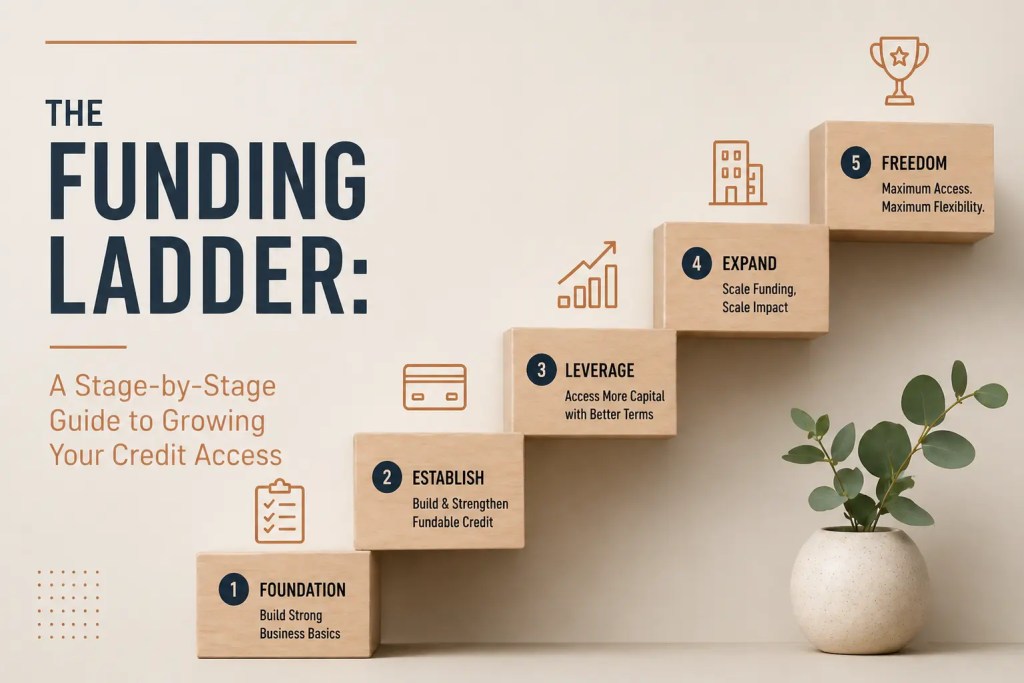
The Funding Ladder is a framework for building credit access in layers — each stage strengthening the foundation for the next. Miss a rung and the whole structure weakens. Build it right and you create a compounding system that turns a $0 credit file into $250K in deployable capital.
—
Your business doesn’t exist to lenders until it has verifiable identity. That means an EIN from the IRS, a registered business entity (LLC or corporation), a dedicated business bank account, and a listed business phone number and address that match across all platforms.
This isn’t paperwork — it’s credibility infrastructure. Lenders and credit bureaus cross-reference your business data against Dun & Bradstreet, Experian Business, and Equifax Business. Inconsistent NAP (Name, Address, Phone) data across these sources will flag your file before a human ever reviews it.
Three actions that make Stage 1 real:
Operators who rush past Stage 1 spend months wondering why their credit applications keep stalling. The answer is almost always a data mismatch or a missing entity layer.
—
A thin credit file is as dangerous as a bad one. With no business credit history, lenders have nothing to underwrite — so they either decline or pull hard inquiries on your personal credit, which erodes your personal score while providing minimal business benefit.
The solution is intentional tradeline development through net-30 vendor accounts. These are suppliers and service providers who extend net-30 payment terms and report your payment history to business credit bureaus. Uline, Quill, Grainger, and similar vendors are common starting points — but the goal is volume and reporting consistency, not brand names.
| Vendor Type | Reports To | Typical Credit Line |
|---|---|---|
| Net-30 Office Suppliers | D&B, Experian Biz | $500–$5,000 |
| Fleet/Fuel Cards | D&B, Experian Biz | $1,000–$10,000 |
| Business Charge Cards | Experian Biz, Equifax Biz | $2,000–$15,000 |
Pay every account early. Net-30 terms mean you can pay in 30 days — paying in 10 or 15 days builds a payment history that scores significantly higher on the PAYDEX scale. A PAYDEX score of 80+ (on a 100-point scale) signals low credit risk and is a prerequisite for most Stage 3 approvals.
Understanding credit leverage at this stage is critical — every tradeline you establish is borrowed credibility that compounds into real purchasing power.
—
Once you have 5–8 reporting tradelines and a PAYDEX above 75, you qualify for business credit cards that report only to business bureaus — not your personal credit. This is the turning point most operators miss.
Business credit cards from issuers like Brex, Ramp, Divvy, and certain bank-issued products are underwritten on your business profile, not your SSN. That means approvals don’t ding your personal score, and the credit limit growth doesn’t affect your personal utilization ratio.
But the real value is behavioral. Business credit cards force discipline — and discipline is what separates operators who scale from those who stagnate. Keep utilization below 30% on each card. Never miss a payment. Request limit increases every 6 months with documented revenue growth.
| Business Credit Card Type | Personal Guarantee Required | Typical Limit Range |
|---|---|---|
| Revenue-based (Brex, Ramp) | No | $5,000–$50,000 |
| Bank-issued business card | Sometimes | $2,000–$25,000 |
| Secured business card | No | $500–$5,000 |
Applying the 2-2-2 credit rule at this stage — targeting 2 cards, 2 bureaus, 2 reporting cycles before escalating — prevents the over-application mistake that tanks files at this critical juncture.
—
Lenders extend credit to businesses they know. A banking relationship — real transaction history, average daily balances, consistent deposits — is underwriting evidence that doesn’t show up on a credit report but influences every decision a bank makes.
Maintain a minimum average daily balance of $10,000–$25,000 in your business checking account for at least 3–6 months before applying for a business line of credit. Banks underwrite on cash flow behavior, not just credit score. Irregular deposits, frequent overdrafts, and low average balances are disqualifying signals regardless of your PAYDEX or FICO.
The Federal Reserve’s Small Business Credit Survey consistently finds that businesses with established bank relationships receive higher approval rates and better terms than those without — a data point most operators never factor into their funding strategy.
At Stage 4, you’re targeting:
The SBA’s loan programs remain one of the most underutilized tools in this range — not because they’re hard to access, but because most operators arrive without the credit profile Stage 1 through 3 were supposed to build.
—
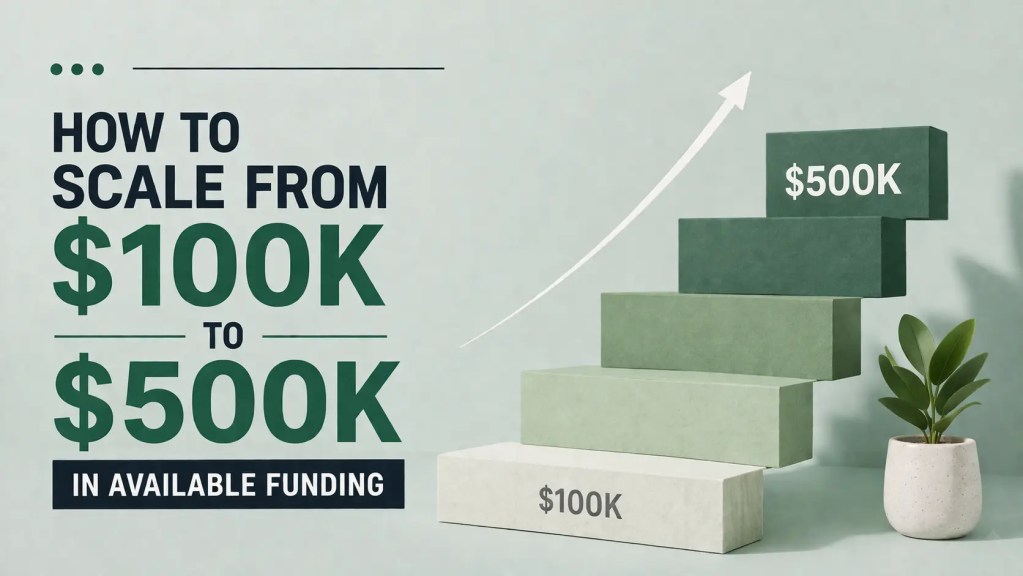
This is where the Funding Ladder pays off. Operators who have built 12–24 months of intentional credit history, maintained strong banking relationships, and demonstrated consistent revenue are positioned to access $50K–$250K in capital — often at 0% introductory rates through business credit stacking strategies.
Credit stacking — applying for multiple business credit products in a coordinated sequence — is a legitimate strategy when executed correctly. The key is timing, sequencing, and bureau management. Apply to the wrong products in the wrong order and you create a pile of hard inquiries with nothing to show for it.
| Funding Vehicle | Typical Range | Key Qualification Factor |
|---|---|---|
| Business credit stacking | $50K–$150K | Strong business credit file, multiple bureaus |
| SBA 7(a) loan | $50K–$250K | 2+ years in business, revenue documentation |
| Bank term loan | $50,000–$500K | Cash flow, collateral, banking relationship |
| Revenue-based financing | $25K–$250K | Monthly revenue consistency |
For a detailed breakdown of how to access capital in this range, business funding solutions covers the mechanics of 0% interest funding and what lenders actually want to see at this level.
Once you secure this capital, deployment strategy matters as much as acquisition. SCORE’s financial management resources offer practical frameworks for turning capital into measurable revenue — because funding without a deployment plan is just liability.
The operators who reach Stage 5 and scale aren’t smarter than everyone else. They’re more patient with the process and more aggressive with the execution once the capital is in hand.
—
Credit access isn’t linear — it’s exponential when staged correctly. A $5,000 net-30 tradeline at Stage 2 becomes the reference point for a $15,000 business card at Stage 3. That card becomes part of the file that justifies a $75,000 line of credit at Stage 4. That line of credit, combined with 18 months of banking history, opens the door to $200,000+ at Stage 5.
This is financial leverage in its most practical form — not theoretical, not abstract, but a concrete sequence that compounds real purchasing power over time.
The operators who fail aren’t the ones who lack access. They’re the ones who skip stages, mistime applications, or treat credit as a one-time event rather than a system to manage. Build the ladder correctly and it holds weight far beyond what you put in.
Most operators can progress from Stage 1 to Stage 3 in 6–9 months with consistent effort. Reaching Stage 5 — $50K–$250K in credit access — typically requires 18–24 months of intentional credit building, banking relationship development, and documented revenue growth.
Not necessarily. Stages 1 through 3 focus on building a business credit profile that’s separate from your personal credit. However, personal credit above 680 will help in Stages 4 and 5, particularly for SBA loans and bank term loans that require a personal guarantee.
Skipping Stage 1. Without a verified business identity — consistent EIN, entity registration, business address, and DUNS number — your credit applications flag before they’re reviewed. No amount of income documentation fixes a missing or inconsistent business identity layer.
Strategic simultaneous applications — known as credit stacking — can work, but only when your business credit file is already established and you’re targeting the right bureaus in the right sequence. Applying too early or without a plan creates multiple hard inquiries with low approval rates and lasting file damage.
There’s no universal threshold, but most lenders targeting the $50K–$250K range want to see at least $10,000–$15,000 in monthly gross revenue with 12+ months of history. SBA programs have more flexibility, while bank term loans and credit stacking strategies typically require stronger revenue consistency.
A better credit score starts with the right strategy. Let Credit Leverage X help you take control of your finances, improve your credit, and unlock the funding you deserve.
Start Your Credit Strategy



Subscribe now to keep reading and get access to the full archive.