Disclaimer: This article is for educational purposes only and does not constitute financial, legal, or investment advice. Credit Leverage X (CLX) educates and mentors entrepreneurs to help them responsibly access and manage business funding for sustainable growth.
TL;DR
Most business owners believe funding speed is the lender’s problem. It isn’t. By the time you submit an application, 80% of the approval outcome is already determined — by decisions you made weeks or months ago. Credit profile, utilization ratio, business age, and average daily bank balance are all pre-baked into your result.
That said, if your fundamentals are reasonably solid, several legitimate capital vehicles can fund within 24–72 hours. The key is knowing which product fits your current profile — and sequencing your applications to avoid unnecessary hard pulls that damage the very score you’re relying on.
This is not a list of random lenders. This is a sequenced strategy.
—
This is the most underutilized fast-funding tool in the market. A well-structured application to the right issuers can yield $20K–$80K in available credit within 5–7 business days — sometimes faster. Zero percent introductory periods of 12–21 months mean you’re accessing interest-free capital, which is a structural advantage most operators ignore while chasing term loans.
Approval speed depends heavily on your personal credit score (720+ is the target threshold) and your existing relationship with major issuers. New business entities with a strong personal credit profile can qualify — you don’t need years of business history for every card product.
Understanding how to maximize this approach is covered in depth in our guide to business funding solutions — including how to stack cards across issuers to reach $50K–$250K without triggering cross-issuer alerts.
| Funding Vehicle | Typical Approval Time | Typical Range | Cost Structure |
|---|---|---|---|
| Business Credit Cards (0% intro) | 5–7 business days | $5K–$80K per card | 0% for 12–21 months |
| Business Line of Credit | 1–5 business days | $10K–$250K | Variable, 7–35% APR |
| Revenue-Based Financing | 24–72 hours | $10K–$500K | Factor rate 1.1–1.5x |
| Merchant Cash Advance | Same day–48 hours | $5K–$250K | Factor rate 1.2–1.5x |
| SBA Express Loan | 36 hours–30 days | Up to $500K | Prime + 2.25–4.75% |
A revolving business line of credit is the most flexible fast-funding tool for operators with at least 6–12 months of business history and $10K+ per month in revenue. Online lenders like Bluevine, Fundbox, and OnDeck routinely approve and fund within 24–48 hours. Traditional banks move slower but offer better rates for operators who qualify.
The critical variable is your average daily balance. Lenders use bank statement analysis to determine cash flow consistency — and a single month of erratic deposits can sink an otherwise strong application. Three months of clean, consistent revenue history is your baseline preparation target.
Revenue-based financing (RBF) ties repayment to a percentage of monthly revenue rather than a fixed payment schedule. For businesses with strong, documented revenue — especially e-commerce, SaaS, or subscription models — RBF lenders can fund within 24–72 hours with minimal documentation beyond bank statements and revenue data.
The tradeoff is real: factor rates between 1.1x and 1.5x mean you’re paying $11,000–$15,000 to borrow $10,000. For short-duration capital needs with a defined ROI event (inventory purchase, contract fulfillment, equipment acquisition), the math can work. For ongoing operating expenses, it’s a trap.
The Federal Reserve’s Small Business Credit Survey consistently shows that operators who use high-cost short-term debt for non-revenue-generating purposes report the highest rates of financial distress within 12 months. Know your use case before you sign.
MCAs are the fastest capital vehicle available — and the most expensive. Same-day to 48-hour funding is standard. But an MCA is not a loan. It is a purchase of future receivables, which means it falls outside traditional lending regulations and carries no APR cap in most states.
Effective APRs on MCAs commonly range from 40% to over 200%. Operators who stack MCAs without a clear exit plan regularly find themselves in a debt spiral that consumes the business. If you’re considering an MCA, the CFPB’s guidance on small business lending transparency is mandatory reading before you sign anything.
MCAs have a narrow legitimate use case: a short-term, high-confidence revenue event where capital access today generates returns that exceed the cost of capital within 60–90 days.
—
Speed of approval is a byproduct of preparation. If you’re applying this week, here is the minimum viable profile for each tier:
For business credit cards and 0% lines:
For business lines of credit (online lenders):
For revenue-based financing and MCAs:
Credit leverage is the underlying mechanic in all of these vehicles. Operators who understand how to build and deploy their credit profile as a capital asset — rather than treating it as a passive score — access funding others can’t. Our breakdown of credit leverage explains the architecture behind this approach.
—
Applications are not free. Every hard inquiry costs 3–7 points and stays on your report for two years. Operators who apply to five lenders simultaneously often disqualify themselves from the best products in the process.
The correct sequence for a 2026 fast-funding push:
1. Pre-screen first. Most online lenders offer soft-pull prequalification. Use it. Know your likely approval range before committing to a hard pull.
2. Apply to card products first. Business credit cards typically use a single hard pull per issuer. Multiple applications in a short window on the personal side may be grouped by credit bureaus — understand your bureau exposure by issuer before applying.
3. Layer in a line of credit second. Once card approvals are confirmed, a business line of credit application adds a separate credit product without cannibalizing card approvals.
4. Use RBF or MCA only as a last layer — and only if the ROI math clears. These products don’t check personal credit the same way, but they do show up in business credit databases used by future lenders.
| Sequence | Product Type | Credit Impact | Funding Speed |
|---|---|---|---|
| Step 1 | Business Credit Cards | Moderate (hard pull) | 5–7 days |
| Step 2 | Business Line of Credit | Moderate (hard pull) | 1–5 days |
| Step 3 | Revenue-Based Financing | Low–None (soft pull) | 24–72 hours |
| Step 4 (if needed) | MCA | Minimal | Same day–48 hours |
—
The SBA Express Loan program offers up to $500K with a 36-hour SBA response window — the fastest SBA product available. Rates are regulated (Prime plus a fixed spread), terms are 7–25 years depending on use of proceeds, and the government guarantee makes approval accessible for operators who don’t qualify for conventional bank financing.
The tradeoff is documentation. SBA Express still requires a business plan summary, 2 years of business tax returns (or personal for newer entities), and a completed SBA application package. It is not a same-day product. But for operators who can prepare documentation over a weekend, funding within the same week is achievable through an SBA-preferred lender.
—
No single fast-approval product typically delivers $250K on its own to a sub-3-year business. The operators who reach that range do it through deliberate stacking:
The total is real. The method is structured. And the cost profile — especially when the card products carry 0% introductory rates — is radically better than most operators assume is possible.
For operators serious about deploying capital efficiently, the framework in how to turn $50K into $250K in revenue shows what disciplined capital deployment actually looks like on the revenue side.
| Stack Component | Typical Amount | Best For |
|---|---|---|
| Business Credit Cards (2–4 cards) | $30K–$80K | Working capital, inventory, SaaS tools |
| Business Line of Credit | $25K–$100K | Recurring operational needs, payroll bridge |
| SBA Express or RBF | $20K–$75K | Growth investments with defined ROI timeline |
Operators who understand financial leverage don’t ask whether to use other people’s money. They ask which structure of borrowed capital generates the best return on equity for their specific use case. That’s the difference between a business that scales and one that stalls.
Get your profile right. Sequence your applications. Know your cost of capital before you commit. Funding this week is possible — but only if you execute like it matters.
For the fastest, lowest-cost options — particularly 0% business credit cards and bank lines of credit — a personal credit score of 720 or above is the practical threshold. Revenue-based financing and MCAs have lower score requirements (some approve at 580+) but carry significantly higher costs. Your score is the single most controllable variable in both approval odds and rate.
Yes, with the right product. Newly formed LLCs and corporations can qualify for business credit cards based primarily on the owner’s personal credit profile, not business revenue history. This is why building personal credit before and during business formation matters. Revenue-based products and lines of credit typically require 3–12 months of documented business revenue.
No more than two to three hard-pull applications in any 30-day window, and sequence them strategically — cards first, then lines of credit. Each hard inquiry temporarily reduces your score, which can affect the next application in your stack. Use soft-pull prequalification tools before committing to any hard inquiry.
In a narrow set of circumstances, yes. If you have a confirmed, high-confidence revenue event — a signed contract, a purchase order, a seasonal spike — where the capital today generates returns that clearly exceed the MCA cost within 60–90 days, the math can justify it. Outside of that specific scenario, the effective APR (often 80–200%) makes MCAs destructive to most businesses over time.
Prepare these before applying to any product: 3–6 months of business bank statements, most recent business and personal tax returns, a voided business check, your EIN and business formation documents, and a one-page use-of-funds summary. Having these ready eliminates the most common cause of application delays — document requests that stall approvals by 3–10 business days.
A better credit score starts with the right strategy. Let Credit Leverage X help you take control of your finances, improve your credit, and unlock the funding you deserve.
Start Your Credit Strategy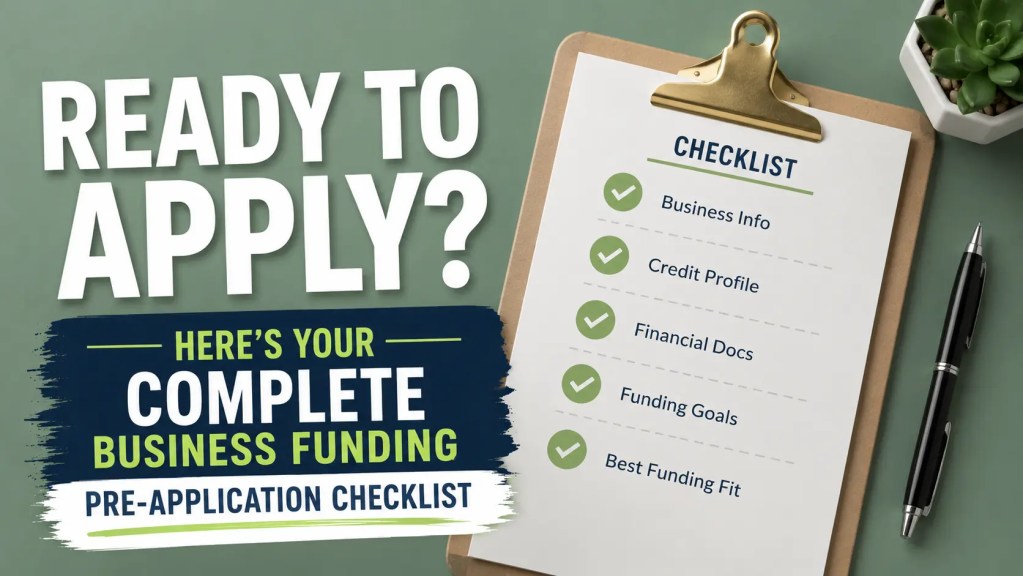





Subscribe now to keep reading and get access to the full archive.