Disclaimer: This article is for educational purposes only and does not constitute financial, legal, or investment advice. Credit Leverage X (CLX) educates and mentors entrepreneurs to help them responsibly access and manage business funding for sustainable growth.
TL;DR
That distinction matters more than most people realize. A damaged profile has derogatory marks, late payments, high utilization — it has history. A zero profile has nothing. No tradelines, no payment history, no score. And to most commercial lenders, nothing looks worse than nothing.
The reset isn’t about disputing errors or waiting out a seven-year clock. It’s about intentional construction — building a business credit identity that lenders can read, trust, and approve. That process is systematic, and it starts before you ever apply for a card or line.
—
Your EIN is not your business credit profile. A lot of operators conflate the two. Your EIN is a tax ID. Your business credit profile lives at Dun & Bradstreet, Experian Business, and Equifax Business — and it’s built through verified business identity signals, not tax filings.
Before you apply for a single tradeline, confirm all of the following are consistent across every platform:
This isn’t bureaucratic box-checking. Lenders run verification against these data points. Inconsistencies flag your profile as high-risk before they ever look at your credit score. One misspelled address between your Secretary of State filing and your bank account can stall an approval.
Sole proprietorships don’t build business credit — they build personal liability. If you’re operating as a sole prop, you’re not building a separate credit entity; you’re exposing your personal profile to every business obligation.
A single-member LLC treated as a disregarded entity has a different risk profile than an LLC with proper business bank accounts, documented revenue, and established vendor accounts. Structure signals intent. Lenders read it.
| Entity Type | Business Credit Buildable? | Personal Liability Protection |
|---|---|---|
| Sole Proprietor | No | None |
| Single-Member LLC | Yes (with proper setup) | Limited |
| Multi-Member LLC | Yes | Strong |
| S-Corp or C-Corp | Yes | Strong |
—
A business checking account with 90+ days of transaction history is the foundation lenders check before anything else. Not your credit score — your banking behavior.
Deposit regularly. Keep a consistent average daily balance. Avoid overdrafts entirely. Lenders — especially those offering business funding solutions at the $50K–$250K range — review 3–6 months of bank statements as part of underwriting. A bank account opened last week doesn’t tell them anything.
This is also where most operators get impatient and skip ahead. They want to apply for credit before their banking history is established. The result is a thin file with no supporting verification — and a decline that adds an inquiry without a return.
—
Random applications don’t build a credit profile. They build inquiries. The credit construction sequence matters because each tier of credit requires the previous tier to already exist.
The tradeline sequence looks like this:
Tier 1 — Starter Vendors (Net-30 accounts): These are vendors who report to the business credit bureaus without requiring an established credit profile. Companies like Uline, Quill, and Grainger extend net-30 terms and report payment history. Pay on time, every time. This is where your D&B Paydex score is born.
Tier 2 — Store and Fleet Cards: Once you have 3–5 reporting tradelines and a Paydex of 80+, you qualify for store credit through retailers like Staples, Home Depot, or Shell. These accounts report to Experian Business and Equifax Business in addition to D&B, broadening your profile.
Tier 3 — Bank-Issued Business Cards: With a multi-bureau profile and 6–12 months of history, you now qualify for Visa/Mastercard business cards with real credit limits. This is the tier that feeds your utilization ratio and creates the leverage profile that matters for larger financing.
| Tier | Account Type | Bureaus Reported | Typical Limit Range |
|---|---|---|---|
| 1 | Net-30 Vendors | D&B | $100–$2,500 |
| 2 | Store/Fleet Cards | D&B, Experian, Equifax | $500–$5,000 |
| 3 | Bank Business Cards | All three | $2,000–$50,000+ |
Understanding credit leverage means recognizing that these tiers aren’t just milestones — they’re multipliers. Each tier expands your borrowing capacity and your lender credibility simultaneously.
—
Two beliefs derail more business credit builds than any other factor.
Misconception 1: Personal credit scores drive business credit approvals. For tier 1 and tier 2 accounts, personal credit is rarely pulled. Starter vendors and store cards are designed specifically to function without a personal credit check, which is why they exist at the foundation of the build. Your personal credit matters later — for bank-issued cards and SBA-backed products — but it’s not the gate at the start.
Misconception 2: More applications mean faster results. Every application that doesn’t result in an approval is a hard inquiry on a thin file. The SBA’s guide to business credit specifically notes that lenders evaluate credit-seeking behavior. A cluster of denials signals desperation. Build the profile first, then apply with precision.
A third misconception worth addressing: age of accounts is irrelevant because you’re a new business. It isn’t. Lenders weigh average account age, and your oldest account sets the floor. The faster you open your first reporting tradeline, the sooner you begin aging toward creditworthiness.
—
Fundable isn’t a feeling — it’s a benchmark. According to Experian’s business credit scoring model, a score of 76–100 indicates low risk. D&B’s Paydex equivalent is 80+. To reach those thresholds you need:
Once you’re here, you’re not just fundable for small vendor accounts. You’re positioned for the capital stack that moves a business — 0% introductory business cards, SBA microloans, and unsecured lines of credit in the $50K–$250K range.
This is where financial leverage stops being theory and starts being an operational tool. Capital at 0% interest deployed into revenue-generating activities isn’t debt — it’s arbitrage.
—
Operators who treat business credit as urgent-but-patient build faster than those who treat it as either an emergency or a long-term project. Here’s a realistic benchmark framework:
| Timeline | Milestone |
|---|---|
| Days 1–30 | Entity verified, D-U-N-S established, bank account opened |
| Days 30–60 | First 2–3 net-30 vendor accounts opened and in use |
| Days 60–90 | First payment cycles reported; Paydex score established |
| Days 90–180 | Tier 2 store/fleet cards approved; multi-bureau profile active |
| Days 180–365 | Tier 3 bank cards approved; profile ready for larger underwriting |
None of this requires perfect execution. It requires consistent execution. Pay every account on time. Keep utilization low. Don’t apply for accounts you’re not ready for. The CFPB’s guidance on business credit reporting reinforces that payment consistency is the single highest-weighted factor across all scoring models.
—
Operators who frame this as a repair project stay in reactive mode. They’re waiting for something to get better. Operators who frame it as a build project stay in motion — because every week they delay opening their first reporting tradeline is a week they’re not aging toward fundability.
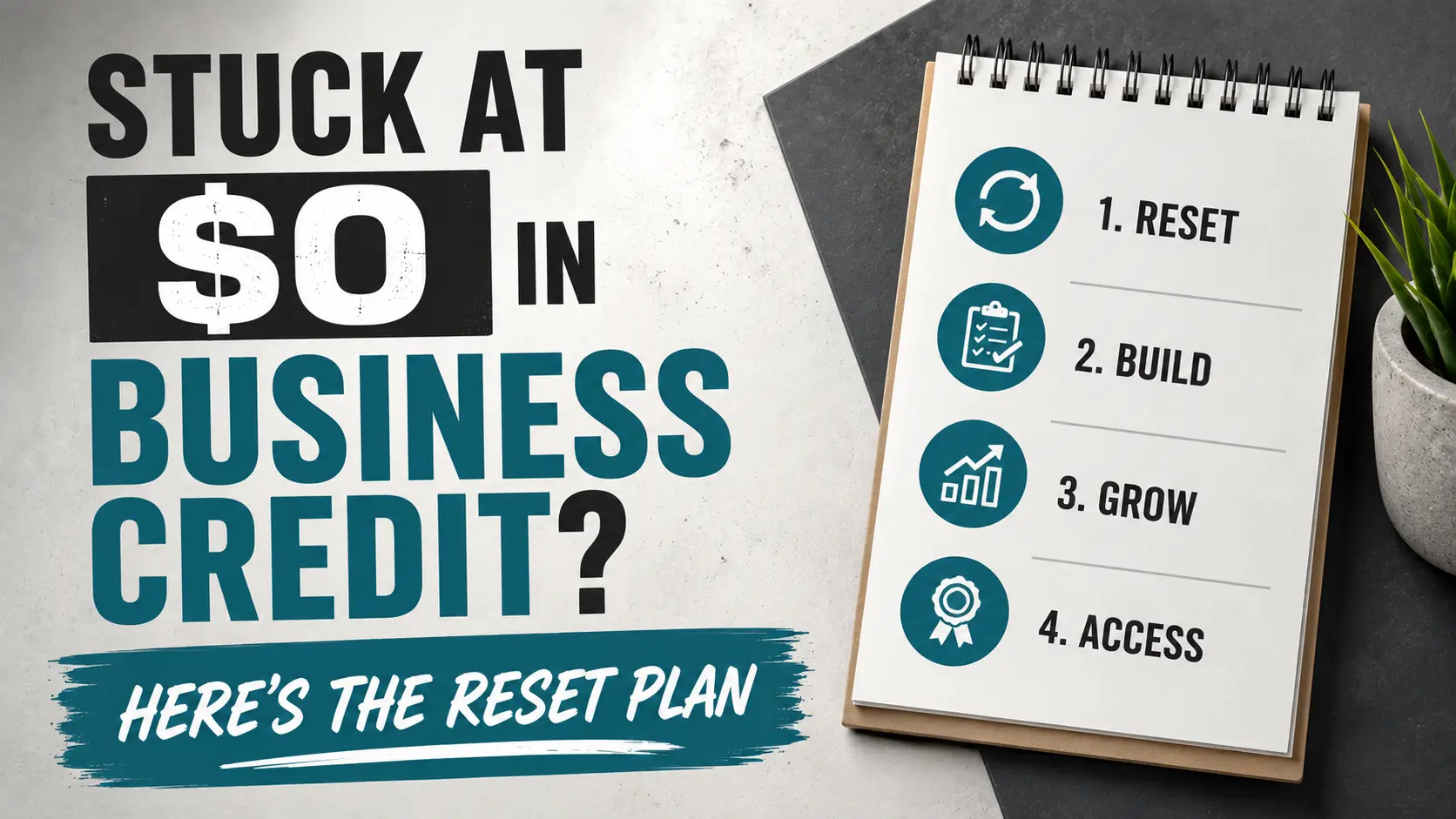
If your business credit sits at $0 today, the reset plan isn’t complicated. It’s sequential. Entity integrity, banking foundation, tiered tradeline construction, and disciplined utilization management. Execute in order. Don’t skip tiers. Don’t rush applications.
The operators who reach $50K–$250K in accessible business capital within 12 months aren’t the ones with the best starting position. They’re the ones who started the sequence the day they understood it.
—
Most operators can establish a fundable business credit profile in 6–12 months if they follow the tier sequence correctly. The first 90 days focus on entity setup and opening starter vendor accounts. By month 6, a multi-bureau profile with 3–5 tradelines is achievable. By month 12, you can realistically qualify for bank-issued business cards and unsecured lines of credit.
For tier 1 starter vendors and some tier 2 store cards, personal credit is often not pulled. However, bank-issued business cards and larger financing products typically require a personal guarantee and will check your personal credit. Building strong business credit doesn’t replace personal credit health — it supplements and eventually reduces your reliance on it.
Yes, for any credit reporting that flows through Dun & Bradstreet — which includes most net-30 starter vendors — you need an active D-U-N-S number. It’s free to register directly through D&B, though the standard process takes about 30 days. An expedited option is available for a fee. Establish it before you open your first vendor account.
Yes. Revenue is not required to begin building a business credit profile. Vendor accounts at the tier 1 level extend credit based on business identity verification, not income. However, revenue becomes relevant when you pursue larger financing — bank cards, lines of credit, and SBA products typically want to see 6–12 months of business bank statements showing consistent cash flow.
Open two to three net-30 vendor accounts with suppliers that report to D&B (such as Uline or Quill), place small orders, and pay the invoices before or on the due date. After one to two payment cycles — typically 30–60 days — your Paydex score will appear. This is the most reliable method to generate an initial score without a personal credit pull.
A better credit score starts with the right strategy. Let Credit Leverage X help you take control of your finances, improve your credit, and unlock the funding you deserve.
Start Your Credit Strategy




Subscribe now to keep reading and get access to the full archive.