Disclaimer: This article is for educational purposes only and does not constitute financial, legal, or investment advice. Credit Leverage X (CLX) educates and mentors entrepreneurs to help them responsibly access and manage business funding for sustainable growth.
TL;DR
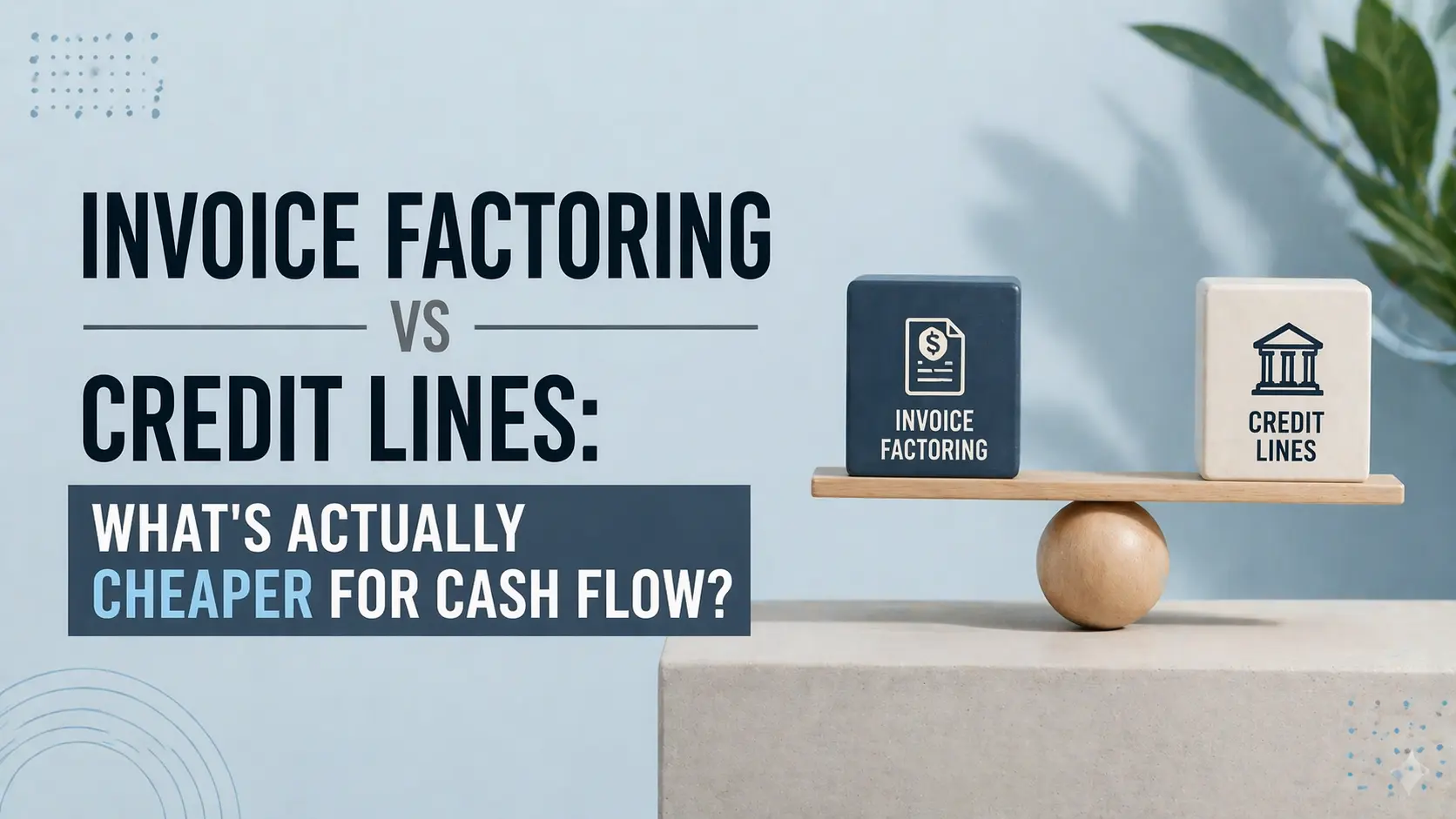
Most business owners frame this as a preference question. “Do I want factoring or a line of credit?” That’s not the right lens. The right question is: which instrument costs less per dollar of liquidity given your specific receivables cycle and credit position?
Get that wrong and you’ll routinely overpay for capital — sometimes by 20, 30, even 40 percentage points annually. That’s not a rounding error. That’s a margin problem.
This breakdown is for operators who want to run the actual math, not just read a feature comparison. We’ll cover real cost structures, when each product outperforms, and how to know which one is eating your cash flow instead of solving it.
—
Factoring is not a loan. That distinction matters legally and practically. When you factor invoices, you’re selling a receivable — a future cash asset — to a third-party factoring company (the “factor”) at a discount. You get cash now; the factor collects from your customer later and keeps the spread.
The factor is underwriting your customer’s creditworthiness, not yours. That’s the structural insight most people miss. A startup with no credit history can access $500K in factored receivables if their clients are creditworthy. No personal guarantee required in many cases. No years-in-business minimums.
Factoring fees are quoted as a percentage of the invoice face value, typically applied per 30-day collection window. Here’s what the real pricing looks like:
| Cost Component | Typical Range | Notes |
|---|---|---|
| Factoring Rate (per 30 days) | 1% – 5% | Applied to invoice face value |
| Advance Rate | 70% – 95% | % of invoice paid upfront |
| Reserve Holdback | 5% – 30% | Released after customer pays |
| Due Diligence / Setup Fee | $0 – $2,500 | One-time, varies by factor |
| Minimum Monthly Volume Fee | Varies | Some factors require $10K–$50K/mo minimum |
Here’s where operators get burned: a 3% factoring fee sounds manageable. But if your customer pays in 60 days, that fee doubles to 6% of the invoice value. Annualized, you’re looking at an effective rate north of 36%. For context, the Federal Reserve’s data on small business lending rates shows average commercial loan rates running well below that — typically in the 7–12% range for creditworthy borrowers.
Factoring is expensive capital. Sometimes it’s the right expensive capital. But go in with eyes open.
—
A business line of credit is a revolving credit facility — you draw what you need, pay interest only on the outstanding balance, repay it, and draw again. It’s the closest thing to on-demand liquidity in commercial finance.
The cost structure is fundamentally different from factoring:
If you draw $50,000 at a 12% APR and repay in 30 days, your cost is roughly $493. Compare that to factoring a $50,000 invoice at 3% — that’s $1,500 for the same 30-day window. The credit line costs less than a third of the factoring cost in this scenario.
That’s the fundamental math. But it only holds if you qualify for the line of credit and can actually get it funded. That’s where the comparison gets more nuanced.
Banks and most institutional lenders require:
If you’re a 14-month-old B2B company with $1.2M in receivables but thin credit history, you likely cannot access a bank line of credit right now. Factoring exists precisely to bridge that gap. Understanding business funding solutions at different business stages helps you map which instruments are even available to you — and which ones you should be building toward.
—
Let’s use a concrete scenario. You have $200,000 in outstanding invoices with net-45 payment terms. You need $150,000 in working capital today.
| Factor | Invoice Factoring | Business Line of Credit |
|---|---|---|
| Amount Accessed | $150,000 (advance on $200K invoices) | $150,000 drawn |
| Cost for 45 Days | ~$9,000 (3% × 1.5 periods) | ~$2,219 (12% APR × 45 days) |
| Qualification Barrier | Low — customer credit matters most | High — your credit and financials |
| Speed to Fund | 24–72 hours typically | Days to weeks for approval |
| Collateral | Invoices (no personal assets) | Often blanket lien or personal guarantee |
| Credit Impact | None (not a loan) | Reports to credit bureaus |
| Recourse Risk | Depends on recourse vs. non-recourse terms | Default triggers collections |
The $6,781 cost difference in this single transaction is significant. Annualized across 8 similar transactions, that’s nearly $54,000 in avoidable financing costs — capital that should be staying in the business.
—
Despite the higher cost, factoring is the better choice in specific, well-defined situations. Don’t dismiss it as a tool — just use it with precision.
Factoring wins when:
SCORE’s small business research consistently shows that cash flow problems are the leading cause of early business failure. Expensive capital accessed in time is frequently worth more than cheap capital that arrives too late.
—
If you qualify, a business line of credit is almost always cheaper for recurring, cyclical cash flow management. The math is simply better for creditworthy operators.
A revolving credit line lets you treat working capital like a utility — draw when you need it, pay it down when receivables clear, draw again next cycle. Used responsibly, it becomes a permanent part of your capital stack without accumulating permanent debt. That’s the power of revolving credit and why understanding financial leverage properly changes how you think about your entire funding strategy.
A line of credit wins when:
One more thing: discipline matters here. A line of credit misused — drawn to fund lifestyle expenses or poor-margin deals — becomes expensive revolving debt that kills liquidity rather than preserving it. The instrument is only as smart as the operator using it.
—
The false binary between factoring and credit lines is the real problem. Sophisticated operators don’t pick one and stick with it. They use both instruments strategically based on the specific cash flow situation in front of them.
Here’s a practical framework:
This is precisely the approach behind credit leverage as a wealth-building discipline: you use available instruments to stay liquid today while systematically qualifying for better, cheaper capital tomorrow.
The SBA’s guide to financing options outlines several federally-backed credit programs that are substantially cheaper than either factoring or conventional lines for qualifying businesses — worth reviewing if you haven’t already.
—
| Scenario | Better Choice | Why |
|---|---|---|
| Startup, <2 years old, strong receivables | Invoice Factoring | Credit line likely unavailable |
| Established business, 680+ credit | Business Line of Credit | Significantly lower APR |
| Single large invoice, enterprise client | Invoice Factoring | Speed + credit risk offload |
| Recurring seasonal cash gaps | Business Line of Credit | Draw-repay cycle is cost-efficient |
| Weak credit, time-sensitive need | Invoice Factoring | Access beats cost in urgent scenarios |
| Building toward 0% promo funding | Business Line of Credit | Credit building is the goal |
—
Invoice factoring is not cheap. It is fast, accessible, and structurally unique — and those properties make it worth the premium in specific circumstances. A business line of credit is cheaper by a wide margin for operators who qualify, but qualification is a real barrier that factoring bypasses entirely.
Don’t let anyone sell you on either product without running your actual numbers. A 3% factoring rate on a net-60 invoice is a 36%+ annualized cost. A 15% APR credit line for 30 days is less than 1.25% of the draw. The decision isn’t philosophical. It’s arithmetic.
No. Invoice factoring is the sale of a receivable, not a loan. It doesn’t appear as debt on your balance sheet, doesn’t require repayment in the traditional sense, and typically doesn’t affect your personal or business credit score. This is one of its core structural advantages for companies that need to preserve borrowing capacity.
Most traditional bank lenders require a personal credit score of at least 680–700, along with 2+ years in business and demonstrable revenue. Online lenders may approve scores as low as 600, but at significantly higher interest rates. If your score is below 650, invoice factoring or revenue-based financing is likely your more viable near-term path.
Yes, and many growth-stage operators do exactly this. The key is to avoid double-pledging the same receivables as collateral. Some credit line agreements include a blanket lien that covers receivables, which could conflict with a factoring arrangement. Review covenants carefully and disclose both facilities to each lender.
In a recourse factoring agreement, you’re responsible if your customer doesn’t pay — the factor can demand the advance back. In a non-recourse arrangement, the factor absorbs the credit loss if your customer defaults. Non-recourse factoring costs more but transfers collection risk, making it valuable when working with newer or less creditworthy clients.
Invoice factoring typically funds within 24–72 hours after invoice verification. A business line of credit can take anywhere from a few days with online lenders to several weeks with traditional banks for approval and first draw. If you’re in a cash flow emergency, factoring’s speed advantage is real and often worth the cost premium.
A better credit score starts with the right strategy. Let Credit Leverage X help you take control of your finances, improve your credit, and unlock the funding you deserve.
Start Your Credit Strategy




Subscribe now to keep reading and get access to the full archive.