Disclaimer: This article is for educational purposes only and does not constitute financial, legal, or investment advice. Credit Leverage X (CLX) educates and mentors entrepreneurs to help them responsibly access and manage business funding for sustainable growth.
TL;DR
Merchant cash advances are sold as convenience. What they actually sell is desperation-priced capital wrapped in language designed to obscure what you’re paying.
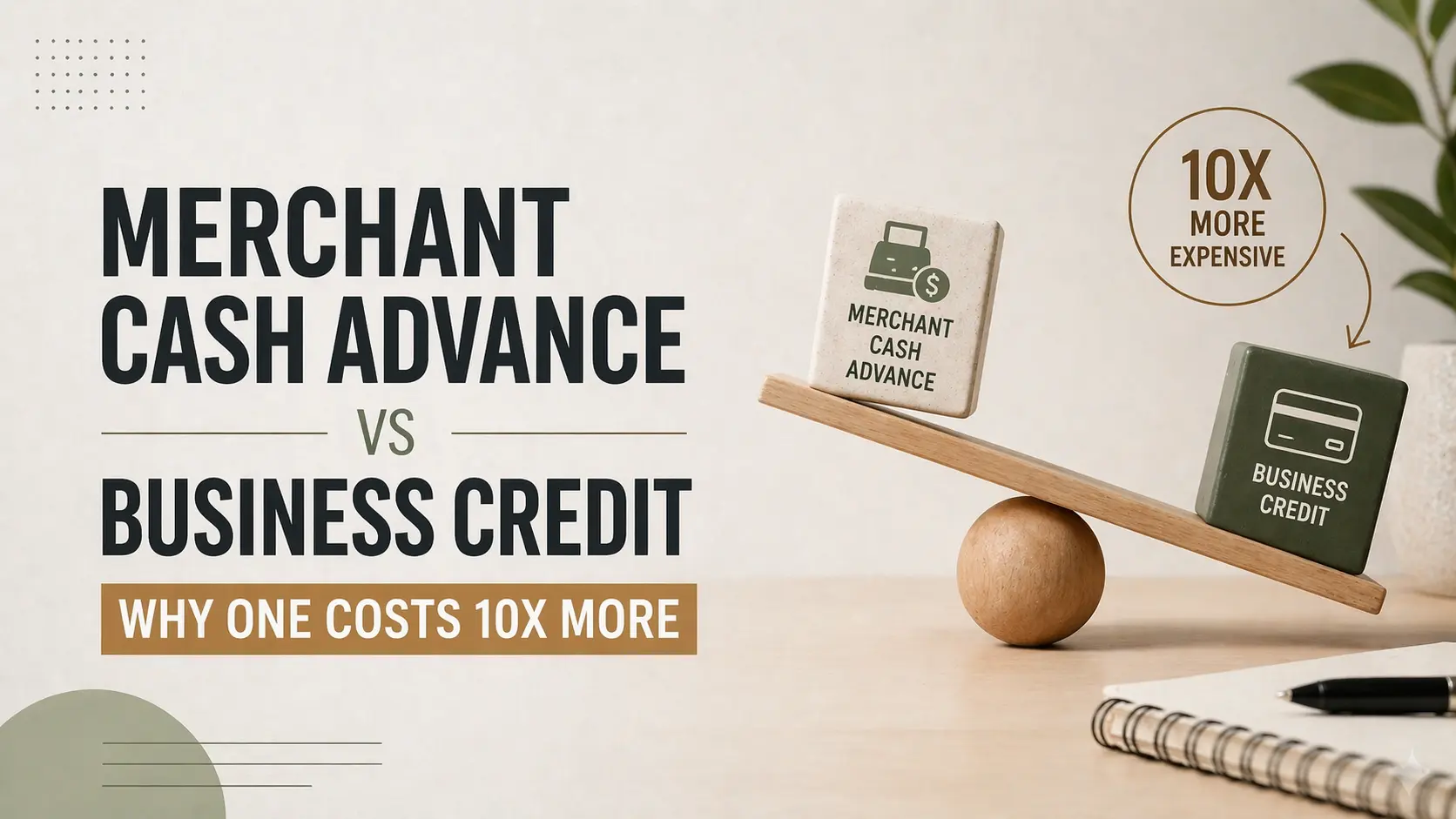
The MCA industry doesn’t quote interest rates. They use factor rates — a number like 1.35 or 1.49 — because it sounds small. It isn’t. When you convert a typical MCA factor rate to an annualized percentage rate, you’re often looking at 80% to 350% APR depending on your repayment speed. Meanwhile, a well-structured business credit line from a bank or credit union runs 7% to 24% APR. That’s not a marginal difference. That’s a fundamentally different financial instrument.
This comparison isn’t academic. It determines whether your business builds equity or bleeds cash.
—
Most operators don’t realize they’re comparing apples to chainsaws when they evaluate MCAs against credit. The pricing mechanics are intentionally different.
An MCA provider advances you $50,000 at a 1.40 factor rate. You now owe $70,000. That $20,000 is the cost of capital — period. It doesn’t matter if you pay it back in 90 days or 300 days. The fee is fixed.
Here’s why that matters: if you repay in 90 days, your effective APR is approximately 160%. If you take 180 days, it’s around 80%. Either way, you’re paying more for money than almost any legitimate lending product on the market.
| Advance Amount | Factor Rate | Total Repayment | Repayment Period | Effective APR |
|---|---|---|---|---|
| $50,000 | 1.40 | $70,000 | 90 days | ~160% |
| $50,000 | 1.40 | $70,000 | 180 days | ~80% |
| $50,000 | 1.25 | $62,500 | 120 days | ~75% |
| $50,000 | 1.49 | $74,500 | 90 days | ~195% |
Compare that to a business credit card at 18% APR or a credit line at prime plus 2%. The spread isn’t 10 percentage points — it’s an order of magnitude.
MCAs don’t have a monthly payment. They pull a fixed percentage of your daily credit card receipts or a fixed daily ACH from your bank account — usually 10% to 20% of gross revenue — until the advance is repaid.
This creates a structural problem. When your revenue dips, your business is already under pressure. The MCA keeps pulling regardless. It doesn’t care about your slow season, your payroll week, or the equipment that broke down. Fixed daily pulls during revenue contractions are exactly how businesses spiral into stacking — taking a second MCA to service the first one. The Federal Reserve’s Small Business Credit Survey has documented that MCA users are significantly more likely to report financial distress than users of traditional credit products.
—
Every dollar you put through an MCA disappears into fees. Every responsible dollar you put through a business credit line builds something.
Business credit — whether structured as revolving credit lines, 0% promotional cards, or term loans — does three things MCAs fundamentally cannot:
Understanding credit leverage is foundational here. Credit isn’t just a tool for a single transaction. It’s a financial infrastructure you build over time — one that compounds in your favor rather than against you.
| Product | Typical Cost | Repayment Structure | Builds Credit? | Scalable? |
|---|---|---|---|---|
| Merchant Cash Advance | 40%–350% effective APR | Daily % of revenue | No | Limited |
| Business Credit Card (0% promo) | 0% for 12–18 months | Monthly minimum | Yes | Yes |
| Bank Business Line of Credit | 7%–18% APR | Monthly interest + principal | Yes | Yes |
| SBA 7(a) Loan | 6.5%–9% APR | Monthly fixed | Yes | Yes |
| Revenue-Based Financing | 15%–60% effective APR | Monthly % of revenue | Sometimes | Limited |
The contrast at the top end is stark. A $100,000 MCA at a 1.40 factor costs $40,000 in fees. A $100,000 business credit line at 12% APR, paid off in 12 months, costs roughly $6,600 in interest. That’s the 10x cost difference in practice.
—
MCAs aren’t always irrational. There are three scenarios where a sophisticated operator might accept MCA terms:
1. Emergency capital with a clear, high-ROI deployment path. If you need $40K in 48 hours to fulfill a purchase order that nets $120K, and no other option exists, the MCA fee may be justified. The math works if the underlying deal clears it.
2. Bridge financing while building credit. Some operators use one MCA — carefully — while simultaneously building business credit infrastructure, with a clear 90-day exit plan.
3. When traditional credit is genuinely unavailable. Businesses under 1 year old with no established credit profile sometimes have no other option. In this case, the MCA is a cost of doing business at an early stage.
But these are exceptions with defined parameters, not a default funding strategy. The problem is that most operators using MCAs fall into none of these categories. They’re using expensive capital for routine working capital needs that business credit could serve at a fraction of the cost.
According to SCORE’s 2023 Megaphone of Main Street report, small businesses that rely on alternative high-cost lenders are significantly more likely to report difficulty servicing debt — a predictable outcome when your cost of capital exceeds your profit margin.
—
The most dangerous pattern in MCA use isn’t the first advance. It’s the second.
Businesses that take an MCA often find their cash flow constrained during repayment. The daily pull reduces the working capital cushion, creating the same problem the MCA was supposed to solve. The next logical move — from the MCA provider’s perspective — is a renewal or a second advance to cover the shortfall. This is called stacking.
Stacking is exactly how a $50,000 funding decision becomes a $200,000 debt problem within 18 months. Each new advance carries its own factor rate, its own fees, and its own daily retrieval. The compounding isn’t working for you here. It’s working against you.
Business credit doesn’t stack in the same destructive way. A credit line gives you access to capital without triggering a new fee event every time you draw. Understanding financial leverage means knowing the difference between leverage that builds capacity and debt that consumes it.
—
Sophisticated operators don’t fund their businesses through a single product. They build a capital stack — layered funding sources at different costs, maturities, and purposes.
A well-constructed stack for a growth-stage business might include:
This structure makes $50K–$250K in business funding solutions accessible at rates that don’t cannibalize your margins. It’s the architecture that serious operators build — not as a one-time event, but as a continuous process of capacity expansion.
The SBA’s guide to business financing outlines the core options available to established businesses, and it’s worth noting that not a single product on their recommended list operates on a factor-rate model.
—
Before you take any advance or apply for any credit, run your decision through three filters:
1. What is the all-in cost of capital? Convert every product to APR. Don’t compare a factor rate to an interest rate — that’s the comparison MCA providers want you to make.
2. What does repayment do to your cash flow? Daily pulls and monthly payments are structurally different. Model both scenarios against your actual revenue pattern, including slow months.
3. What does this do to my credit profile in 12 months? MCAs don’t build your credit. Business credit does. Every funding decision is also a credit infrastructure decision.
If you’ve built the right credit profile and capital relationships, you should rarely — if ever — need an MCA. The goal is to make high-cost emergency capital unnecessary through proactive credit development.
| Decision Filter | MCA | Business Credit |
|---|---|---|
| All-in APR | 80%–350% | 0%–24% |
| Cash flow impact | Daily revenue pull | Predictable monthly |
| Credit profile effect | None | Builds over time |
| Emergency use case | Acceptable | Preferred when available |
| Long-term strategy | Avoid | Core infrastructure |
The math is unambiguous. The only question is whether you have the credit infrastructure to access better capital. If you don’t, building it is the priority — not normalizing 150% APR as the cost of doing business.
Most MCAs carry effective APRs between 80% and 350%, depending on the factor rate and how quickly you repay. Because MCAs use factor rates rather than interest rates, the true annualized cost is rarely disclosed upfront. Always convert the factor rate to APR before comparing it to any other funding product.
Yes — and for most working capital needs, 0% promotional business credit cards are a far superior option. Many business credit cards offer 12–18 months of 0% APR on purchases and balance transfers, giving you interest-free capital that also builds your business credit profile. This is one of the most underutilized tools in small business finance.
Generally, no — and that’s part of the problem. Most MCA providers do not report to business credit bureaus like Dun & Bradstreet or Experian Business, which means years of MCA payments build zero credit history. Business loans and credit lines that report to bureaus create a compounding credit asset. MCAs do not.
Most bank business lines of credit require a personal FICO score of 680 or higher, at least 2 years in business, and $100K+ in annual revenue. Some credit unions and online lenders will work with scores as low as 620. If you’re below those thresholds, the priority is building your profile — not taking expensive alternative capital — so your next funding round comes at a sustainable cost.
Rarely, but yes. An MCA can be justified when you have a specific, high-ROI deployment — like fulfilling a purchase order that will generate a net profit well above the MCA fee — and no other capital source is available in time. Outside of that narrow scenario, the cost is almost never justified compared to properly structured business credit. If you find yourself considering an MCA for routine working capital, that’s a signal to prioritize credit development, not normalize expensive borrowing.
A better credit score starts with the right strategy. Let Credit Leverage X help you take control of your finances, improve your credit, and unlock the funding you deserve.
Start Your Credit Strategy





Subscribe now to keep reading and get access to the full archive.