Disclaimer: This article is for educational purposes only and does not constitute financial, legal, or investment advice. Credit Leverage X (CLX) educates and mentors entrepreneurs to help them responsibly access and manage business funding for sustainable growth.
TL;DR
Most business operators approach debt the same way they were taught to approach personal finances: pay it down as fast as possible, stay out of the red, sleep better at night. That instinct is costing them serious growth capital.
The truth is, not all debt is created equal — and the decision to pay it down versus stack more funding is one of the most consequential capital allocation choices you’ll make as an operator. Get it wrong in either direction and you’re either suffocating your business with high-cost obligations or burning liquidity on debt that was never a problem.
This framework gives you a clear, structured way to make that call.
—
Business owners who conflate all debt as a liability are leaving real money on the table. The banks, private equity groups, and sophisticated operators you’re competing against use leverage as a growth mechanism. They’re not paying down 0% lines of credit — they’re deploying them.
Understanding financial leverage is the foundation here. Borrowed capital that generates returns exceeding its cost is not a burden — it’s a multiplier. The goal isn’t a debt-free balance sheet. The goal is an optimized one.
That said, certain debt structures actively damage your credit profile, restrict your cash flow, and block you from accessing better capital. That kind of debt needs to go — fast.
Before you make any paydown or funding decision, classify your current obligations:
Productive Debt — Low-interest or 0% business credit, SBA loans with favorable terms, equipment financing with asset backing. This debt costs you little and, deployed correctly, generates ROI above its cost.
Toxic Debt — Merchant cash advances (MCAs), high-APR short-term loans, revenue-based financing at premium factor rates. This debt drains cash flow daily, often carries factor rates of 1.2x–1.5x or more, and actively suppresses your ability to qualify for better funding.
Your first move in any capital strategy is identifying which bucket each obligation sits in.
—
There is no universal right answer between paydown and stacking. The right answer comes from running four variables against your current position.
This is the mathematical core of the decision. If your debt costs 8% annually and your next deployment of capital returns 20%+, paying down that debt first is a losing trade.
| Debt Cost (APR) | Expected Capital ROI | Recommended Move |
|---|---|---|
| 0% – 8% | 15%+ | Stack funding, deploy aggressively |
| 8% – 18% | 18%+ | Stack funding, accelerate paydown in parallel |
| 18% – 35% | Below 20% | Pay down debt first, reposition |
| 35%+ (MCA/short-term) | Any | Eliminate immediately — this is financial drag |
The SBA’s guide on business loan types breaks down common debt structures and their typical cost ranges — use that as a reference point when benchmarking your obligations against market norms.
Your credit utilization ratio, debt-to-income (DTI) ratio, and credit age all determine how much additional funding you can access — and at what terms. Carrying certain high-balance revolving debt can suppress your business credit scores even if payments are current.
If your current debt load is actively hurting your fundability, paydown isn’t just a financial decision — it’s a positioning play. Reducing utilization below 30% on revolving accounts can meaningfully shift your profile within 30–60 days. Eliminating an MCA obligation removes a red flag that many institutional lenders use to disqualify applicants outright.
Understand credit leverage as a long-term asset. Every decision you make today either builds or erodes the credit infrastructure that supports your next funding round.
Funding isn’t always available on demand. Lenders change programs, credit markets tighten, and 0% promotional periods expire. If you’re sitting on an open line of credit or a pre-qualification that expires in 60 days, the right move may be to stack that capital now — even if you carry some existing debt — rather than lose the access window.
This is especially true for operators pursuing business funding solutions in the $50K–$250K range. That tier of capital requires clean credit, strong documentation, and active relationships with the right lenders. Waiting until your balance sheet looks “perfect” often means waiting too long.
Debt paydown accelerates your net worth on paper. But it also depletes liquid reserves. If paying down $40K in debt leaves you with $10K in operating capital and no available credit, you’ve created a liquidity crisis in exchange for a cleaner balance sheet.
Operators need a minimum operational runway before committing capital to paydown. As a rule:
—
There are situations where the math, the strategy, and the logic all point the same direction: eliminate the debt first.
MCA or High-Factor Debt — Any obligation with a factor rate above 1.25 or an effective APR above 40% is costing you compounding capital that no deployment strategy can reliably beat. These obligations also signal distress to future lenders. Get out of them.
Debt That Restricts New Funding Access — Some loan agreements include stacking restrictions or covenants that prohibit taking on additional financing. If your current debt is blocking you from accessing better capital, it has to go first.
Debt-to-Income Ratio Above Lender Thresholds — According to the Federal Reserve’s small business credit survey, high debt burden is among the top reasons small businesses are denied financing. If your DTI is disqualifying you from the next funding tier, strategic paydown unlocks access — and that access is worth more than the liquidity you spend to get there.
Psychological Drag That Limits Decision-Making — This one operators won’t admit, but it’s real. If a debt obligation is creating stress that’s affecting how you run the business, that has a real operational cost. Eliminating it buys clarity.
—
The case for stacking new funding is strongest when your existing debt is structured favorably and the incoming capital has a clear, high-ROI deployment path.
| Situation | Existing Debt Profile | Stacking Decision |
|---|---|---|
| Inventory purchase at 40% margin | 0%–8% revolving debt, low utilization | Stack — clear ROI exceeds cost |
| Equipment acquisition with asset value | SBA loan at 6.5%, stable cash flow | Stack — asset-backed, favorable terms |
| Marketing campaign with proven CAC | Business line at prime + 2% | Stack — measurable return |
| Working capital gap | No existing debt, open credit available | Stack — protect operations |
| Speculative new market entry | MCA outstanding, high DTI | Hold — stabilize first |
The operators who scale from $50K to $250K in revenue consistently aren’t the ones with zero debt — they’re the ones who understand how to turn $50K into $250K in revenue by deploying borrowed capital into high-leverage business activities with measurable return cycles.
You can’t stack quality funding on a damaged credit profile. If your business credit is thin, your utilization is high, or your payment history has blemishes, the funding you stack will come at punitive rates — which shifts the calculus entirely.
Before any stacking strategy, your credit infrastructure needs to be solid:
Investopedia’s breakdown of business credit scores is worth reviewing if you need a reference point on how lenders evaluate these factors in practice.
—
Here’s how to apply this framework in 10 minutes with your actual numbers.
Step one: List every current debt obligation with its effective APR, monthly payment, and remaining balance. Separate them into productive and toxic buckets.
Step two: Calculate your current DTI and revolving credit utilization. Note whether either figure is likely disqualifying for your next funding target.
Step three: Identify any active funding opportunities — pre-qualifications, open applications, expiring promotional windows — and assign them a time sensitivity rating.
Step four: Map your deployment plan. If you stack capital today, where does it go and what return does it generate in 90–180 days? If that return doesn’t clear your cost of capital by at least a meaningful margin, the case for stacking weakens.
Step five: Run the liquidity test. After either paydown or stack, what is your liquid reserve position? If it drops below 3 months of operating expenses, reconsider the timing.
This is not a complex analysis — but most operators skip it entirely and make the decision based on emotion or habit. The ones who do the math consistently outperform.
—
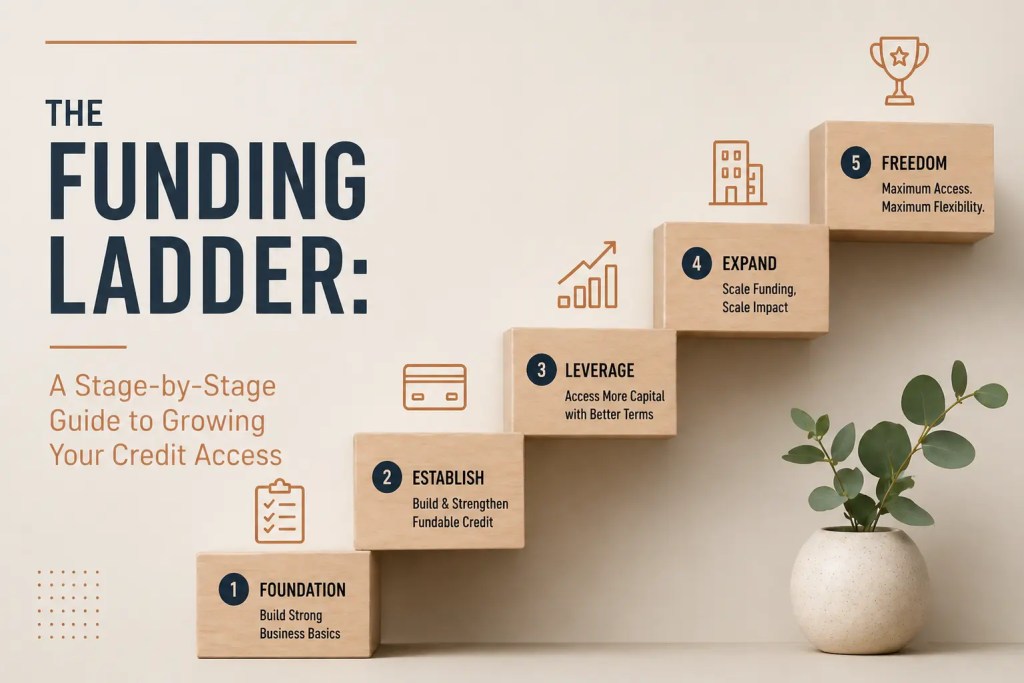
The best capital move isn’t always binary. Sophisticated operators run both strategies in sequence:
1. Eliminate toxic debt (MCA, high-factor obligations) first — even if it requires short-term belt-tightening
2. Rebuild credit utilization and DTI to qualifying thresholds
3. Access the next tier of funding at favorable terms (0% promotional, SBA-backed, institutional lines)
4. Deploy that capital into high-ROI activities while carrying the low-cost debt as productive leverage
5. Repeat the cycle — each iteration at a higher capital base
This is the compounding structure that separates operators running at $500K annually from those running at $5M. The difference isn’t access to secret funding sources — it’s disciplined capital sequencing.
The framework isn’t complicated. The discipline to execute it is.
—
In almost every case, yes. MCAs carry effective APRs that often exceed 40–100%, create daily cash flow drag, and signal distress to institutional lenders. Most quality lenders will either deny your application outright or offer punitive terms if an active MCA is showing. Eliminate it first, allow 30–60 days for your profile to stabilize, then pursue better-structured capital.
Yes — if your existing debt is structured favorably (low APR, no stacking restrictions in your loan covenants), your DTI is within lender thresholds, and your credit utilization is below 30%. The key variable is whether your new capital has a clear deployment path with a return that meaningfully exceeds its cost. Stacking for the sake of having more capital without a plan is how operators create overleveraged, fragile balance sheets.
Strategically, paying down revolving debt reduces your credit utilization ratio, which can improve your business credit scores within one to two billing cycles. Eliminating obligations also lowers your DTI, which directly impacts how much additional funding you can access and at what terms. The tradeoff is reduced liquidity — so paydown should be timed when you have sufficient operating reserves and no imminent capital deployment needs.
Most institutional lenders and business credit card programs prefer to see revolving utilization below 30% across all accounts. Some premium programs and 0% promotional products require utilization below 20–25%. If you’re above 50% utilization, paydown to qualifying thresholds should be a priority before any new funding application — the improvement in approval odds and interest terms typically justifies the capital deployed toward reduction.
It depends on what the capital solves. If tight cash flow is a timing issue — receivables delayed, seasonal gap, inventory pre-purchase — then a short-term line of credit or working capital facility can be the right move, provided the cost is manageable and the capital directly closes the gap. If tight cash flow reflects a structural revenue problem, adding debt accelerates the problem rather than solving it. Capital solves timing gaps and funds growth. It doesn’t fix a broken business model.
A better credit score starts with the right strategy. Let Credit Leverage X help you take control of your finances, improve your credit, and unlock the funding you deserve.
Start Your Credit Strategy




Subscribe now to keep reading and get access to the full archive.