Disclaimer: This article is for educational purposes only and does not constitute financial, legal, or investment advice. Credit Leverage X (CLX) educates and mentors entrepreneurs to help them responsibly access and manage business funding for sustainable growth.
TL;DR
Most operators don’t have a business credit problem. They have a sequencing problem. They apply for funding before their business looks like a real, creditworthy entity to lenders — and then wonder why they get denied or stuck with unfavorable terms.
Building business credit isn’t complicated. But it is sequential. Skip a step, and the whole structure is compromised. Do it right, and you can access business funding solutions at terms that would be impossible through personal credit alone.
Here’s the exact framework.
Your business needs a verifiable identity before any bureau will track it or any lender will trust it. This isn’t administrative busywork — it’s the infrastructure that makes credit possible.
Four non-negotiable requirements:
A registered agent address or virtual office is acceptable for many lenders, but a physical, verifiable address always performs better. If you’re operating from home, consider a commercial mailbox through a service like Regus or a UPS Store with a real suite number.
Personal credit bureaus track you automatically. Business credit bureaus don’t. If you haven’t proactively registered, you may not have a file at all — which means every application you submit is evaluated blind, and lenders default to your personal credit.
The three bureaus that matter:
| Bureau | Profile Name | Why It Matters |
|---|---|---|
| Dun & Bradstreet | DUNS Number | Required by most major vendors and federal contractors |
| Experian Business | Business Credit Report | Used by many commercial lenders and card issuers |
| Equifax Business | Business Credit Report | Commonly pulled for lines of credit and equipment financing |
Obtaining a DUNS number from Dun & Bradstreet is free. Expedited registration is paid but unnecessary if you’re planning 60–90 days out. Apply early and let the file age while you work the rest of the sequence.
The SBA’s guide to business credit confirms what experienced operators already know: lenders rely heavily on these bureau files, and gaps in reporting can kill deals that should close.
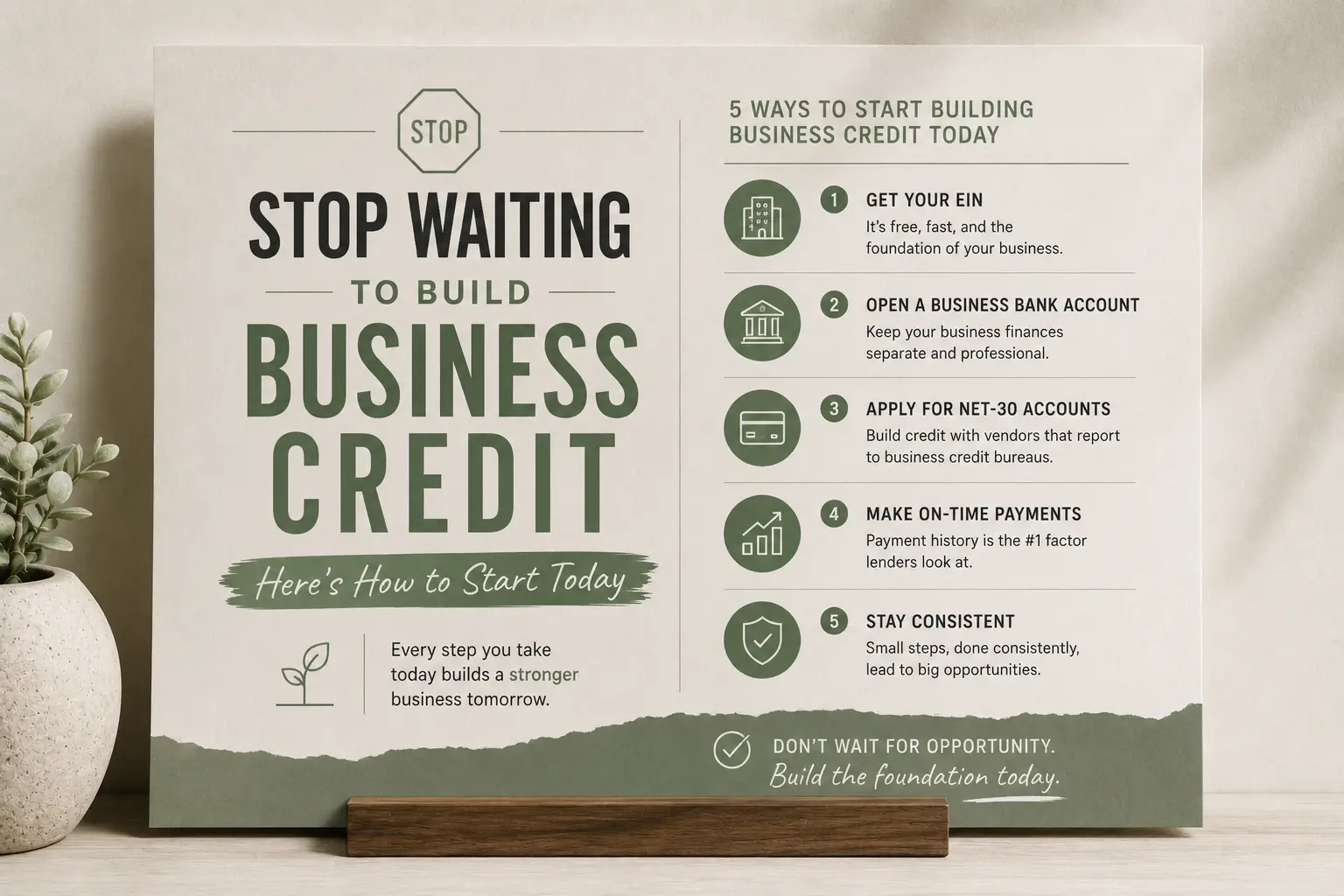
Corporate credit cards and bank lines of credit require an existing profile to approve. That creates a catch-22 for new files. Net-30 vendor accounts solve this.
Net-30 accounts extend you trade credit — you purchase inventory, supplies, or services and pay within 30 days. The vendor reports your payment history to the bureaus. Pay early or on time consistently, and you build a positive payment history without a hard pull or personal guarantee (at many vendors).
Starter vendors known to report to business bureaus include Uline, Quill, Grainger, and Crown Office Supplies. You don’t need to purchase large quantities. Small, consistent orders paid promptly do exactly what you need them to do.
Open three to five net-30 accounts in the first 30–60 days. Use them. Pay them. Let them report. This is how you generate a Paydex score with D&B (their primary payment performance metric, scored 0–100) and establish initial tradelines with Experian and Equifax Business.
| Metric | Target |
|---|---|
| Net-30 tradelines reporting | 3–5 accounts |
| Payment history | 100% on-time or early |
| D&B Paydex Score | 80+ |
| Business bureau files open | All three (D&B, Experian, Equifax) |
| Business bank account age | 60+ days with regular activity |
This profile won’t qualify you for a $250K credit line on day 91. But it positions you to graduate into business credit cards, revolving trade credit, and eventually bank financing — each step building on the last.
Most operators think about credit transactionally: they need money, so they apply. That’s not leverage — that’s dependency.
Credit leverage is the strategic accumulation of borrowing capacity that can be deployed on your terms, not the lender’s. Understanding credit leverage reframes the entire process. You’re not trying to borrow money. You’re building an asset — a credit infrastructure that grows more valuable the longer you maintain it.
The compounding mechanics work like this: Net-30 accounts establish a score. The score qualifies you for business credit cards with real limits. Those cards, used and managed correctly, build higher scores and longer history. Higher scores unlock bank lines of credit. Bank lines of credit, used strategically, qualify you for larger term loans and SBA-backed products.
Skip the sequence and you’re starting over every time. Follow it and each layer funds the next.
Building a fundable business credit profile is straightforward — but it’s easy to sabotage.
The Federal Reserve’s Small Business Credit Survey consistently shows that underprepared applicants — those without established credit files and clean financial records — face significantly higher denial rates and worse terms than their prepared counterparts. Preparation isn’t a soft advantage. It’s a measurable one.
Business credit builds faster than most operators expect, provided the sequence is followed without shortcuts.
| Phase | Timeline | Milestone |
|---|---|---|
| Foundation | Days 1–30 | Entity, EIN, bank account, NAP consistency, bureau registration |
| Tradeline establishment | Days 30–90 | 3–5 net-30 accounts reporting, Paydex score generated |
| Credit card tier | Months 3–6 | Starter business cards, $2K–$10K limits |
| Revolving credit tier | Months 6–12 | Higher-limit cards, net-60/net-90 vendor accounts |
| Bank financing tier | Months 12–24 | Lines of credit, SBA products, term loans |
Operators who reach month 12 with clean files, consistent revenue, and low utilization ratios are the ones accessing $50K–$250K in capital without personal guarantees. That’s the real objective. Understanding the 2-2-2 credit rule will help you navigate the specific benchmarks lenders use to evaluate readiness at each tier.
The operators who access capital on favorable terms aren’t smarter. They started earlier. They built the profile before they needed it, which means they negotiate from a position of strength rather than urgency.
Every day you delay is a day of credit history you can’t get back. File the EIN. Open the bank account. Register with D&B. Get three net-30 accounts open this week. The entire sequence starts with those four actions — and none of them require capital to execute.
The credit infrastructure you build today is the leverage you deploy tomorrow.
A fundable starter profile with bureau files and reporting tradelines can be established in 60–90 days. A full credit profile capable of qualifying for $50K+ in financing typically takes 12–18 months of consistent, strategic activity.
Yes — that’s the objective. Net-30 vendor accounts, many starter business cards, and most trade credit products don’t require a personal guarantee once you have an established profile. The early stages may involve a personal credit check, but the goal is to graduate out of personal guarantee requirements entirely.
No. Bureau registration, net-30 tradelines, and the foundational steps don’t require revenue. However, you’ll need consistent bank account activity and eventually documented revenue to qualify for larger credit products at the bank financing tier.
Personal scores (FICO) range from 300–850. Business scores vary by bureau — D&B Paydex runs 0–100, Experian Business Intelliscore runs 0–100, and Equifax Business uses multiple scoring models. Unlike personal credit, business credit files are not automatically created and must be actively established.
Three to five reporting tradelines is the standard threshold. You want at least 60–90 days of payment history on those accounts before submitting a business credit card application. Applying on a thin or empty file almost always results in denial or personal-guarantee-only approvals.
A better credit score starts with the right strategy. Let Credit Leverage X help you take control of your finances, improve your credit, and unlock the funding you deserve.
Start Your Credit Strategy





Subscribe now to keep reading and get access to the full archive.