
Disclaimer: This article is for educational purposes only and does not constitute financial, legal, or investment advice. Credit Leverage X does not guarantee specific loan approvals or funding outcomes. Always consult a licensed financial professional before making credit or funding decisions.
If you’ve ever applied for a business loan, real estate financing, or line of credit, chances are the lender mentioned something called your DSCR — short for Debt Service Coverage Ratio.
This key metric determines how capable you are of repaying borrowed money using your business or investment income. Whether you’re applying for an SBA loan, real estate funding, or business line of credit, your DSCR can make or break the approval process.
Understanding this ratio isn’t just about securing loans — it’s about learning how lenders think and how to strategically position your finances for long-term leverage.
The Debt Service Coverage Ratio (DSCR) measures a business’s ability to cover its debt payments — both principal and interest — using its net operating income (NOI).
The formula is simple but powerful:

Where:
Net Operating Income (NOI) = Revenue – Operating Expenses
Total Debt Service = Principal + Interest payments over a year
If a business earns $120,000 per year and owes $100,000 in total annual debt payments:
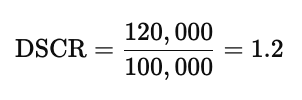
This means the business earns 1.2 times what it needs to repay debt — a 20% income cushion.
Lenders use DSCR as a safety indicator. A higher DSCR means lower lending risk.
1.25 or higher: Excellent — strong borrower with sufficient cash flow.
1.1–1.24: Acceptable, though lenders may impose stricter terms.
Below 1.0: Risky — indicates that income doesn’t fully cover debt.
If your DSCR is below 1.0, it signals to lenders that you’re borrowing more than you can currently support, which can lead to denial or higher interest rates.
Investors use DSCR to measure property performance — whether rental income can cover mortgage payments.
Example:
Annual Rent Income: $60,000
Mortgage + Taxes + Insurance: $48,000
DSCR=60,00048,000=1.25\text{DSCR} = \frac{60,000}{48,000} = 1.25DSCR=48,00060,000=1.25
This shows the property is profitable and sustainable — exactly what lenders want to see.
For SBA and commercial loans, DSCR reflects how well your business profits can service its debts.
SBA lenders typically require DSCR ≥ 1.25.
A DSCR below 1.15 may trigger loan denials or requests for collateral.
Revenue Volatility – Unstable income reduces predictability.
High Fixed Costs – Expenses that don’t scale down can drag DSCR down.
Short-Term Debts – Larger monthly payments lower the ratio.
Interest Rate Increases – Variable loans can erode your DSCR cushion.
Underreported Income – Not recording full earnings can make ratios look worse on paper.
Understanding these factors helps entrepreneurs plan proactively — keeping DSCR strong before applying for new funding.
Improving DSCR isn’t just about earning more — it’s about managing your cash flow smarter.
Boost revenue through marketing and new clients.
Reduce unnecessary operational expenses.
Automate to cut labor costs.
Replacing expensive debt with 0% APR funding (like CLX strategies) can drastically improve DSCR immediately.
Extending repayment schedules lowers monthly payments, improving your ratio.
Separating business expenses from personal debt gives a clearer, stronger DSCR profile for lenders.
Lenders prefer stable obligations — applying for new credit can temporarily lower your DSCR.
At Credit Leverage X (CLX), we help entrepreneurs not only build strong personal credit but also prepare their financial profiles to qualify for business funding and loans.
Here’s how CLX helps optimize DSCR:
Debt Restructuring: Transitioning high-interest consumer debt to 0% APR business credit lines.
Revenue-Focused Mentorship: Teaching clients how to allocate funds into income-producing assets (eCommerce, AI trading, automation).
Funding Sequencing: Structuring credit applications to avoid DSCR shocks before major funding rounds.
Financial Readiness: Helping clients present professional, lender-ready documentation that highlights strong cash flow.
With CLX’s strategies, entrepreneurs learn to leverage credit while maintaining healthy DSCR — ensuring lenders view them as low-risk, high-potential borrowers.
Ignoring Cash Flow Projections: Lenders always assess future stability, not just current performance.
Mixing Personal & Business Finances: This creates misleading DSCR results.
Overestimating Income: Inflated income projections lead to rejections or overborrowing.
Underutilizing Leverage: Some borrowers with high DSCRs miss opportunities to grow by staying too conservative.
CLX teaches clients how to balance leverage and liquidity for maximum impact — maintaining a DSCR that satisfies lenders while still using credit strategically to build wealth.
Traditional lenders see DSCR as a static measure, but CLX views it dynamically:
A strong DSCR provides access to better credit leverage opportunities.
Strategic use of 0% APR funding can improve DSCR long-term by increasing revenue capacity.
For example:
An entrepreneur refinances $30K of high-interest debt using CLX’s funding solutions.
Monthly obligations drop by $600.
DSCR rises from 1.1 to 1.4 — instantly more attractive to lenders.
This dual approach — combining credit leverage with financial discipline — enables entrepreneurs to sustain growth while remaining lender-ready.
DSCR (Debt Service Coverage Ratio) measures your ability to repay debt.
A ratio above 1.25 is ideal for lenders and signals strong financial health.
Improving DSCR requires better income management and lower-cost financing.
Credit Leverage X helps entrepreneurs boost DSCR through 0% APR funding, smarter credit management, and mentorship.
Understanding DSCR is essential not just for loans — but for long-term wealth creation through leverage.
Book a no-cost strategy call and get expert guidance, personalized solutions, and real opportunities to move your goals forward.
Get StartedMost lenders look for 1.25 or higher, meaning your income should be 25% greater than your debt obligations.
CLX helps clients qualify for funding and prepare profiles lenders love, but doesn’t issue loans directly.
Yes — lenders evaluate your full debt profile, including personal obligations.
In many cases, within 30–60 days through debt restructuring and strategic funding.
A strong DSCR reflects financial stability, improving business valuation, credit approvals, and investor confidence.
A better credit score starts with the right strategy. Let Credit Leverage X help you take control of your finances, improve your credit, and unlock the funding you deserve.
Start Your Credit Strategy







Subscribe now to keep reading and get access to the full archive.