Disclaimer: This article is for educational purposes only and does not constitute financial, legal, or investment advice. Credit Leverage X (CLX) educates and mentors entrepreneurs to help them responsibly access and manage business funding for sustainable growth.
TL;DR
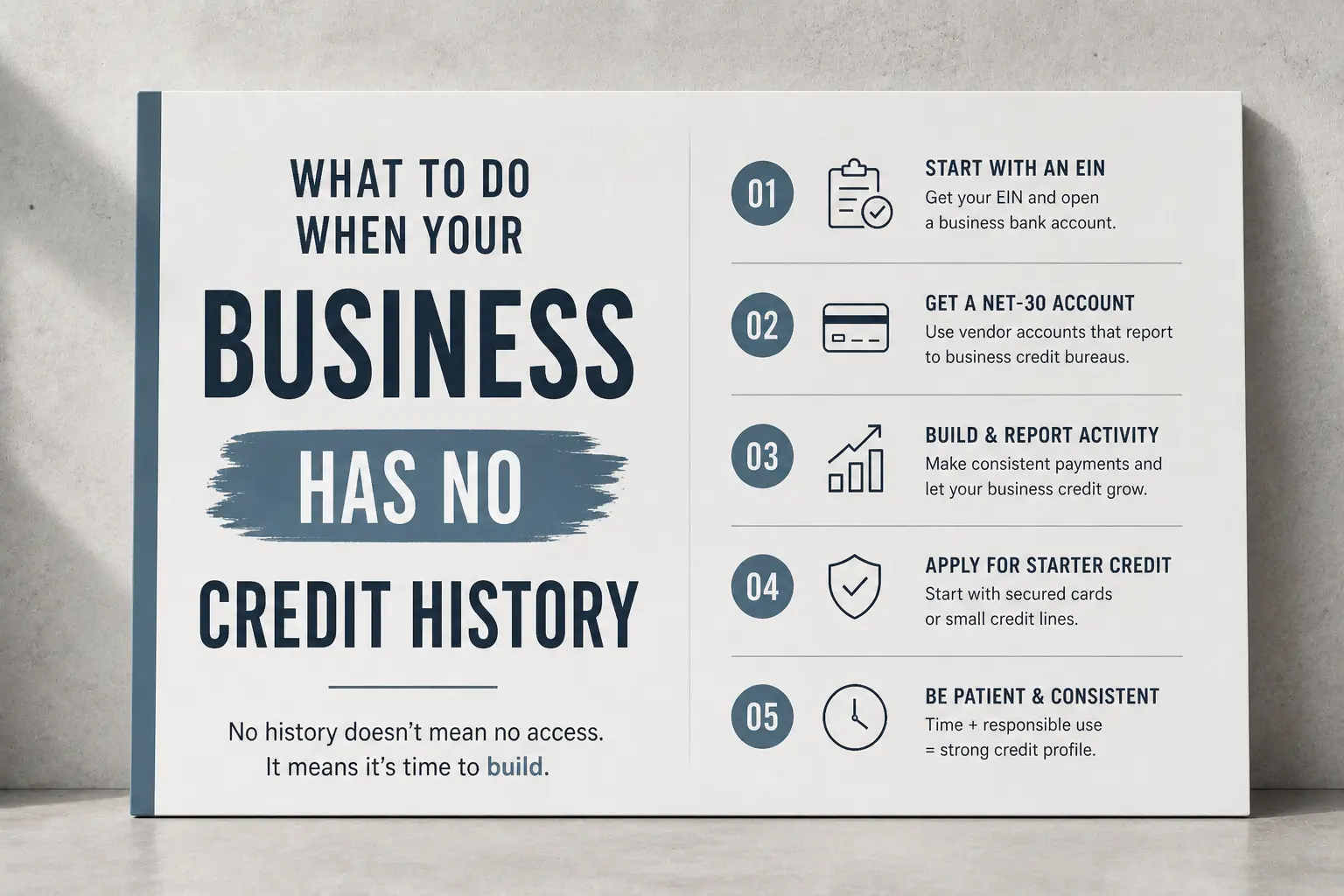
Most operators make a costly assumption when they launch: they believe having no business credit history puts them in the same category as a business with damaged credit. It does not. A blank file and a bruised file are two entirely different risk signals to lenders and vendors. A blank file means unproven. A damaged file means unreliable. Unproven can be fixed in 90 to 180 days with the right sequence of moves. Damaged takes years.
Understanding that distinction changes your strategy completely. You are not rehabilitating anything. You are building — and building has a clear, repeatable process.
Credit doesn’t attach to a concept. It attaches to a legal entity with verifiable credentials. Before you apply for anything, your business structure has to be lender-ready. Most early-stage operators skip or rush this layer, then wonder why they get declined.
Every fundable business needs the same base layer in place:
This infrastructure is what separates a registered business from a fundable business. They are not the same thing.
The fastest way to build a business credit profile from nothing is through net-30 vendor accounts — also called trade credit. These are vendor relationships where you purchase goods or services and pay the invoice within 30 days. When those vendors report your payment history to business credit bureaus like Dun & Bradstreet, Experian Business, or Equifax Business, your profile begins to populate.
Not all vendors report. That’s a critical detail most guides omit. Vendors in the starter tier that are known to report include Uline, Quill, Grainger, and Crown Office Supplies — among others. Apply to three to five of these, make small purchases, pay early or on time, and let the reporting cycle work.
| Vendor | Reports To | Net Terms | Approval Difficulty |
|---|---|---|---|
| Uline | D&B | Net 30 | Low |
| Quill | Experian, D&B | Net 30 | Low |
| Grainger | D&B | Net 30 | Low–Medium |
| Crown Office Supplies | D&B | Net 30 | Low |
| Nav Business Credit | Experian | Revolving | Low |
Three to five active, reporting trade lines are typically the minimum threshold to generate a scoreable Paydex score. Dun & Bradstreet requires at least three trade references to calculate a score. Aim for a Paydex of 80 or above, which signals on-time payment.
With no business credit history, lenders will look at your personal credit score as a proxy for your financial behavior. That’s not something to resent — it’s something to leverage strategically. A personal score above 680 opens a meaningful range of options, including business credit cards, SBA microloans, and certain term loan products.
According to the Federal Reserve’s Small Business Credit Survey, personal credit scores remain one of the top approval factors for small business loan applications, particularly for firms under two years old. Knowing this, your job is to keep your personal profile clean while your business profile matures — not to choose one over the other.
Some operators misread this phase and go all-in on personal credit, maxing out personal cards for business expenses. That approach destroys your personal utilization ratio, suppresses your score, and disqualifies you from the business funding products you’re trying to reach. Keep personal utilization below 30 percent. Keep business expenses on business accounts wherever possible.
For a deeper look at how borrowed capital compounds into real business growth, read our breakdown of financial leverage and how operators use it to scale without giving up equity.
Sequence matters more than speed. Applying for the wrong products too early generates hard inquiries, produces declines, and can actually delay your profile development. The right order looks like this:
Phase 1 — Months 1 to 3: Establish entity infrastructure. Open net-30 vendor accounts. Open a business checking account and maintain consistent deposits.
Phase 2 — Months 3 to 6: Apply for a business credit card with the bank where you hold your business checking account. Relationship banking matters here. Secured business credit cards are an option if unsecured approval is premature. Pay in full each cycle.
Phase 3 — Months 6 to 12: With three or more trade lines reporting and a business credit card in use, begin targeting store credit with business retailers (Staples, Home Depot, Amazon Business). These approvals build profile depth.
Phase 4 — Month 12 and beyond: With an established profile, pursue revolving credit lines, SBA loan products, and ultimately unsecured business funding in the $50K–$250K range.
| Phase | Timeframe | Primary Action | Credit Bureau Impact |
|---|---|---|---|
| 1 | 0–3 months | Vendor trade lines | D&B Paydex initiated |
| 2 | 3–6 months | Business credit card | Experian, Equifax Business |
| 3 | 6–12 months | Retail business credit | Profile depth increases |
| 4 | 12+ months | Unsecured funding pursuit | Full fundable profile |
Understanding the 2-2-2 credit rule gives you a specific structural benchmark for what lenders want to see before extending serious capital — worth reviewing before you move into Phase 4.
Business credit reports contain errors more often than most operators expect. According to SCORE, inaccurate or missing trade line data is a common issue that can suppress your profile without you knowing it.
Monitor your business credit reports across all three bureaus — Dun & Bradstreet, Experian Business, and Equifax Business — at minimum quarterly. If a vendor is not reporting, follow up directly. If an account shows incorrect payment status, dispute it in writing with supporting documentation.
Optimization at this stage also means managing your business credit utilization. Just as with personal credit, high utilization on business revolving accounts suppresses scores. Keep utilization below 30 percent on business cards and lines of credit.
The end goal isn’t a number. It’s a complete profile that signals creditworthiness to institutional lenders. That profile includes:
When all of these elements align, you’re no longer applying for credit. You’re presenting a fundable business — and there’s a significant difference in how lenders respond. For the full picture of what becomes accessible at that stage, see our guide to business funding solutions and how to structure access to $50K–$250K in capital.
Building business credit from nothing to fundable takes six to twelve months when executed correctly. Operators who shortcut the sequence — skipping entity structure, applying for products out of order, or relying exclusively on personal credit — typically take two to three years to reach the same outcome, if they get there at all.
| Starting Point | Estimated Timeline to Fundable Profile | Key Accelerator |
|---|---|---|
| Zero infrastructure | 10–14 months | Entity setup first |
| Entity exists, no credit | 6–10 months | Net-30 vendor accounts |
| Some trade lines reporting | 3–6 months | Card + retail stacking |
| Full profile, low scores | 6–12 months | Dispute + utilization fix |
The process is not complicated. It is sequential. Follow the sequence, document everything, and treat your business credit profile as a fundable asset — because that’s exactly what it is.
Yes, but your options are limited and the terms will reflect the risk. Microloans through SBA intermediaries, revenue-based financing, and certain CDFI lenders work with businesses that have thin or no credit profiles. These are bridge options — the goal is to use them while building a proper credit file, not to rely on them long-term.
With the right sequence — entity setup, net-30 vendor accounts, a business credit card, and consistent on-time payments — most operators can reach a scoreable, lender-recognized profile in six to twelve months. Skipping steps or applying out of order extends that timeline significantly.
Directly, in the early stages. Most lenders use a personal credit check as a proxy when your business profile is thin. A score above 680 improves your access to starter products. As your business profile matures and revenue is verifiable, personal credit becomes less central to lender decisions.
The Paydex score is Dun & Bradstreet’s business payment performance score, ranging from 1 to 100. A score of 80 means you pay on time. A score of 100 means you pay early. Most lenders targeting the $50K–$250K range want to see a Paydex of 80 or above alongside scores from Experian Business and Equifax Business.
Eventually, yes. In the early phase, most unsecured products will require a personal guarantee or personal credit check. As your business profile strengthens — multiple reporting trade lines, verified revenue, two or more years in business — you can access products that rely primarily on your business profile and reduce or eliminate personal guarantee requirements.
A better credit score starts with the right strategy. Let Credit Leverage X help you take control of your finances, improve your credit, and unlock the funding you deserve.
Start Your Credit Strategy




Subscribe now to keep reading and get access to the full archive.