Disclaimer: This article is for educational purposes only and does not constitute financial, legal, or investment advice. Credit Leverage X (CLX) educates and mentors entrepreneurs to help them responsibly access and manage business funding for sustainable growth.
TL;DR
Here’s the uncomfortable truth most financial educators won’t say directly: a significant portion of business owners who believe they are building business credit have no commercial credit file at all. They have an EIN. They have a bank account. They may have a business credit card. But from the perspective of Dun & Bradstreet, Experian Business, or Equifax Business — they are a ghost.
Commercial bureaus do not automatically receive or compile your data. Unlike personal credit, where lenders routinely report to all three major bureaus, business credit reporting is fragmented, inconsistent, and largely opt-in. If your vendors and creditors don’t report to commercial bureaus — or if your business isn’t properly registered in those systems — nothing accumulates.
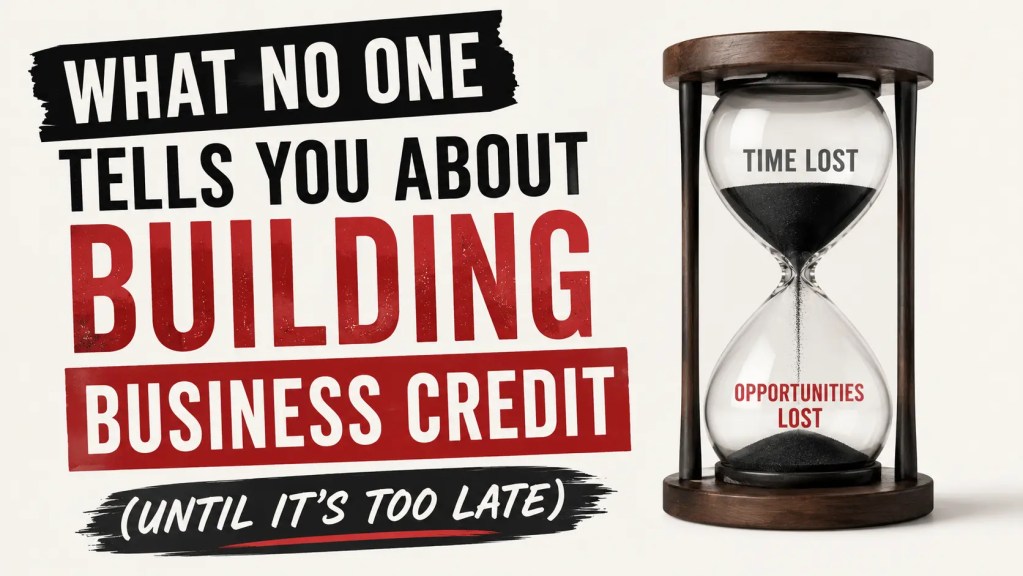
The clock doesn’t start running until your foundation is built correctly.
—
Before any tradeline matters, your business entity must be verifiable and consistent across every major data source. This is called fundability infrastructure, and it is the non-negotiable prerequisite for a commercial credit profile that lenders actually trust.
The details have to match — exactly — across your Secretary of State filing, IRS EIN documentation, business bank account, website, and directory listings like Google Business Profile, 411, and Dun & Bradstreet’s own database.
Key elements that must be consistent and correctly formatted:
Without this infrastructure locked down, lenders who pull your commercial profile will either find nothing or find inconsistencies that immediately reduce your fundability score. Neither outcome moves you toward capital.
—
Most operators assume that paying business bills on time means credit is accruing. It isn’t — unless those vendors report to commercial bureaus. The majority of vendors, suppliers, and service providers do not report payment history anywhere.
The vendors that do report — often called net-30 trade accounts or starter vendors — are the actual mechanism for building initial business credit. Accounts from companies in the office supply, packaging, shipping, and business services sectors are commonly used because several within those categories report to D&B, Experian Business, or Equifax Business on a monthly basis.
Here’s how the reporting landscape generally breaks down:
| Vendor Type | Likelihood of Reporting to Commercial Bureaus |
|---|---|
| Net-30 starter vendors (targeted) | High — this is the point of using them |
| Major retail business credit cards | Moderate — varies by issuer |
| General suppliers and distributors | Low — most do not report |
| Utility and telecom accounts | Low to moderate — inconsistent |
| SBA and bank business loans | High — but require existing credit history |
This is why starter vendor strategy matters. You use reporting vendors to build the file, then leverage that file to access higher-tier credit instruments. It is a deliberate sequence, not a passive accumulation.
For a deeper look at how structured leverage compounds over time, see credit leverage and how it applies beyond just credit cards.
—
Mixing personal and business finances does not just create accounting headaches. It actively undermines your business credit profile.
When business expenses run through personal accounts, commercial bureaus receive no signal. Your business entity has no payment history to report. Your business bank account shows no meaningful cash flow pattern. And when a lender evaluates your business for a line of credit or term loan, they are looking at a shell — an entity with an EIN and nothing else behind it.
The IRS and the SBA both identify co-mingling of funds as a serious risk factor for small business financial health. It also exposes your personal assets to business liability in ways that proper entity structuring is designed to prevent.
Separation is not just best practice. It is a prerequisite for the profile you’re trying to build.
—
Operators with stalled or non-existent business credit profiles tend to show a predictable set of characteristics. Recognizing them early means you can fix the specific problem rather than doing generic credit-building work that doesn’t move the needle.
| Profile Problem | Root Cause | Targeted Fix |
|---|---|---|
| No commercial file exists | D-U-N-S not established, no reporting vendors | Register with D&B, open net-30 accounts that report |
| File exists but no score | Not enough tradelines or too few months of history | Add 3–5 reporting vendor accounts, wait 60–90 days |
| Score exists but too low | Late payments, high utilization, or derogatory data | Pay down balances, dispute inaccuracies, add positive tradelines |
| Strong file, can’t get approved | Fundability gaps — mismatched business data | Audit and correct all business registration and directory data |
| Approved for low limits only | Thin file or short history with major issuers | Extend age of accounts, add reporting accounts consistently |
The Federal Reserve’s Small Business Credit Survey consistently shows that financing gaps for small businesses often trace back to creditworthiness issues — not lender unwillingness. The profile is the constraint.
—
There is no hack here. There is a sequence. Operators who follow it build fundable profiles in 90 to 180 days. Those who skip steps waste years.
Pull your current data from D&B, Experian Business, and Equifax Business. Verify that your business name, address, and phone number are consistent everywhere. Correct any mismatches before proceeding.
If you don’t have a D-U-N-S number, register at Dun & Bradstreet directly. Verify that your NAICS code accurately reflects your industry — a mismatch here can affect your risk tier with lenders who use automated underwriting.
Focus on vendors with a documented history of reporting to commercial bureaus. Make small purchases. Pay invoices before the due date, not just on the due date. Early payment signals appear in Paydex and similar bureau scoring models as stronger than on-time payment.
If you are not already familiar with the 2-2-2 credit rule, this framework gives operators a structured progression for building business credit across tiers — from vendor accounts to business credit cards to financing instruments. It prevents the common mistake of applying for credit instruments before the profile is ready to support them.
According to Experian’s business credit resources, errors in commercial credit files are more common than most operators realize and do not get corrected automatically. Monitor all three commercial bureaus quarterly. File disputes on any inaccurate or outdated information immediately.
—
Once your business credit profile hits functional thresholds — generally a Paydex of 80 or above, three or more active reporting tradelines, and 12 months of payment history — the access to capital changes qualitatively, not just quantitatively.
You become eligible for revolving business credit lines, fleet accounts, and eventually bank-tier financing — the kind that funds growth without equity dilution or predatory interest rates. That is the real value of a strong commercial credit profile. Not the score itself, but the doors it opens.
Operators who understand this use business credit as a leverage tool, not a safety net. For a practical look at how that capital can be deployed, see business funding solutions and the mechanics of accessing $50K–$250K at structured rates.
Build the profile. Build it correctly. Then use it.
With the right structure — a verified D-U-N-S number, three to five reporting vendor accounts, and consistent on-time payments — most operators see a scoreable commercial profile within 90 to 120 days. A fundable, lender-ready profile typically takes six to twelve months of deliberate account management.
Only if the card issuer reports to commercial bureaus — and many do not, or report only to personal bureaus. Before opening any business credit account, confirm which commercial bureaus the issuer reports to. An unreported account builds nothing on your commercial profile.
Yes, but with limitations. Many starter vendor accounts and certain business credit cards do not require a personal credit check. However, as you move toward higher-tier credit instruments and bank financing, lenders will often perform a personal guarantee check. Building business credit in parallel with repairing personal credit is the strongest long-term strategy.
On-time payment produces a Paydex of 80. To push above 80, you need to pay invoices early — before the due date, not on it. Additionally, a thin file with fewer than three reporting tradelines limits score movement. Add more reporting accounts and ensure existing vendors are actually reporting to D&B.
Pull your reports from all three commercial bureaus directly. File formal disputes for any inaccurate or outdated entries — bureaus are required to investigate. Simultaneously, add new positive tradelines to dilute the impact of negative history. Derogatory marks on commercial files do not carry the same statutory protections as personal credit, so proactive monitoring and rapid disputing is essential.
A better credit score starts with the right strategy. Let Credit Leverage X help you take control of your finances, improve your credit, and unlock the funding you deserve.
Start Your Credit Strategy





Subscribe now to keep reading and get access to the full archive.