Disclaimer: This article is for educational purposes only and does not constitute financial, legal, or investment advice. Credit Leverage X (CLX) educates and mentors entrepreneurs to help them responsibly access and manage business funding for sustainable growth.
TL;DR
Most operators think about credit the wrong way — as something you apply for when capital gets tight. That reactive posture is precisely why so many businesses plateau at the same revenue ceiling year after year.
Infrastructure, by definition, is built before you need it. Roads don’t get paved after traffic jams start. Servers don’t get provisioned after the app crashes. Credit works the same way. The businesses that consistently access $50K–$250K in growth capital aren’t scrambling — they built the system months or years earlier, and they’re simply drawing from it.
This isn’t a philosophical reframe. It’s a structural advantage.
—
When operators treat credit as a last resort, the damage compounds silently. By the time they need capital, their profile is thin, their utilization is spiked, or their file has derogatory marks from a period they didn’t monitor. The bank sees a risk. The window closes.
The real cost isn’t the declined application — it’s the opportunity that expired while you were trying to qualify. Inventory deals, acquisition targets, hiring windows, equipment buys — capital-sensitive opportunities don’t wait for a credit profile to catch up.
Consider the contrast:
| Reactive Operator | Infrastructure Operator |
|---|---|
| Applies for credit during cash crunch | Maintains revolving credit lines year-round |
| Personal credit mixed with business | Separate, seasoned business credit file |
| High utilization at time of need | Sub-20% utilization, optimized reporting dates |
| Denied or offered high-rate products | Qualifies for 0% intro or prime-rate facilities |
| Funding takes 30–90 days to secure | Capital accessible within days |
The right column isn’t luck. It’s the result of treating credit like any other operational system that requires consistent maintenance.
—
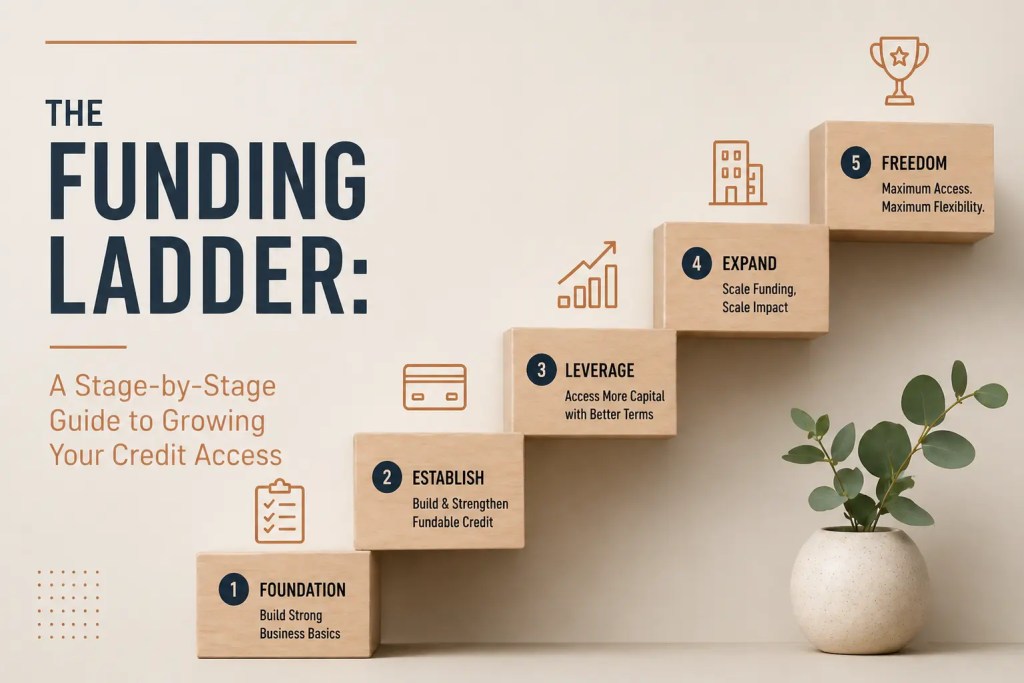
Building credit infrastructure isn’t complicated, but it is sequential. Layers have to be established in the right order, and each layer supports the next.
Your business entity, EIN, dedicated business bank account, and business address form the base layer. Without a clean separation between personal and business finances, every credit application is evaluated against your personal profile — which limits both capacity and terms. Lenders and credit bureaus treat an entity with its own banking history as a more creditworthy subject. This is table stakes.
The credit profile itself is built through strategic tradeline accumulation — vendor accounts, net-30 suppliers, secured business cards, and revolving lines that report to Dun & Bradstreet, Experian Business, and Equifax Business. Operators who understand credit leverage know that a single well-placed tradeline isn’t the goal; it’s the layered combination of account types, ages, and limits that builds lender confidence.
Not all tradelines are equal:
| Tradeline Type | Reporting Impact | Speed to Establish |
|---|---|---|
| Vendor/Net-30 accounts | Builds payment history fast | 30–60 days |
| Secured business credit card | Adds revolving history | 30–90 days |
| Unsecured business card | Increases limit capacity | 60–120 days |
| Bank line of credit | Signals institutional trust | 6–18 months |
| SBA-backed facility | Maximum credibility signal | 3–24 months |
Most operators with decent profiles still make a structural error: they don’t manage utilization as an active variable. Credit utilization — the ratio of balances to available limits — has an outsized effect on both personal FICO scores and business credit ratings. The 2-2-2 credit rule offers a systematic framework for managing this across multiple accounts and reporting cycles, helping operators maintain clean profiles even while actively using their credit.
The discipline here is calendar-based. When your statement closes, what does your utilization look like? If you’re running 60–80% across revolving lines to float operational expenses, you’re training the credit bureaus to see you as a high-utilization borrower — which throttles limit increases and raises flags for new applications.
—
Here’s the argument most advisors won’t make clearly: debt capital, structured correctly, is almost always superior to equity capital for operators who have the credit infrastructure to access it.
Equity financing means selling ownership. You give up a percentage of future revenue and decision-making authority in exchange for capital now. The cost is permanent and compounding. Credit-based capital — especially 0% introductory facilities — has a fixed, knowable cost that expires. When deployed strategically, the return on that capital exceeds its cost by a factor that equity simply can’t replicate.
The SBA Office of Advocacy consistently finds that small businesses with access to credit lines and term debt grow faster and hire more than those dependent on equity or personal savings. The mechanism is straightforward: credit provides flexibility without dilution.
For operators pursuing the $50K–$250K range, understanding the full spectrum of business funding solutions makes the infrastructure case concrete — these facilities exist, the rates are real, and the qualification criteria are navigable with the right credit profile in place.
—
Once credit infrastructure is in place, it doesn’t just sit there — it appreciates. Accounts age, limits increase, new facilities become available, and lenders begin treating you as an established borrower rather than a startup risk.
This compounding dynamic is what separates operators who access capital once from those who use it as a permanent strategic asset. The Federal Reserve’s Small Business Credit Survey shows that firms with 5+ years of credit history are approved for financing at nearly twice the rate of younger firms — and at substantially better terms.
Building that track record isn’t passive. It requires:
This isn’t a one-time setup. It’s an ongoing operational discipline — the same way a serious operator manages their P&L, their pipeline, and their payroll.
—
Accessing $50K–$250K in credit-based capital is only half the equation. The operators who convert that capital into compounding revenue understand deployment sequencing — matching each capital instrument to the right use case based on term, cost, and return timeline.
0% introductory credit is ideal for short-cycle, high-return deployments: inventory, marketing campaigns, equipment with fast payback periods. Longer-term facilities should be matched to longer-term investments. Mixing these up — using short-term credit for long-term assets — creates the cash flow crunches that damage credit profiles in the first place.
For a rigorous framework on turning funded capital into scalable revenue, how to turn $50K into $250K in revenue lays out the deployment logic that experienced operators use.
According to Investopedia’s analysis of business credit utilization, operators who maintain strategic utilization ratios and deploy capital against defined ROI targets consistently outperform peers who treat credit as an emergency buffer.
The mindset shift is this: credit infrastructure is not a safety net. It is a growth engine. Build it that way.
—
One final distinction serious operators need to make. Building credit infrastructure is not the same as becoming dependent on credit to cover operational shortfalls. If your business model only works when you’re borrowing, the problem isn’t your credit profile — it’s your unit economics.
| Infrastructure Mindset | Dependency Pattern |
|---|---|
| Credit used for growth and opportunity | Credit used to cover operating losses |
| Facilities maintained with low utilization | Lines consistently maxed out |
| Capital deployed against measurable ROI | Capital consumed without clear return |
| Profile improves over time | Profile deteriorates under load |
| Options expand with each cycle | Options narrow with each cycle |
Credit infrastructure works because it starts from a position of operational strength — and amplifies it. It is not a substitute for business fundamentals. But for operators who have those fundamentals in place, it is the single most powerful and underutilized lever available.
Business credit infrastructure refers to a deliberate, layered system of accounts, entities, banking relationships, and utilization habits built over time to ensure reliable access to capital. Having good credit is a snapshot. Infrastructure is the architecture that produces and maintains that snapshot consistently — and that continues to improve and expand your funding capacity as your business grows.
Most operators can establish a fundable business credit profile within 6–12 months if they follow a structured approach: entity setup, business banking, vendor tradelines, secured and then unsecured revolving accounts. Access to larger facilities in the $100K–$250K range typically requires 12–24 months of seasoned history and consistent utilization discipline.
Personal credit is a supporting factor, not the foundation. Lenders use personal FICO scores as a secondary check, and most serious business credit facilities prefer a score above 680–700. However, the primary goal is to build a business credit file that stands on its own — reducing personal liability and increasing business borrowing capacity independently of your personal profile.
Applying for credit reactively — when they already need capital — is the most common and costly mistake. At that point, cash flow stress often shows up as high utilization or late payments, which are exactly the signals that cause lenders to decline or restrict offers. Credit infrastructure has to be built during periods of operational stability, not crisis.
Yes. 0% introductory APR business credit cards and lines, when stacked across multiple accounts by an operator with a strong credit profile, can generate $50K–$250K in interest-free capital with 12–18 month utilization windows. The key is understanding which products offer these terms, how to qualify, and how to deploy the capital before the introductory period expires. This is a legitimate and widely used strategy among experienced operators.
A better credit score starts with the right strategy. Let Credit Leverage X help you take control of your finances, improve your credit, and unlock the funding you deserve.
Start Your Credit Strategy




Subscribe now to keep reading and get access to the full archive.